
Progressive Rock
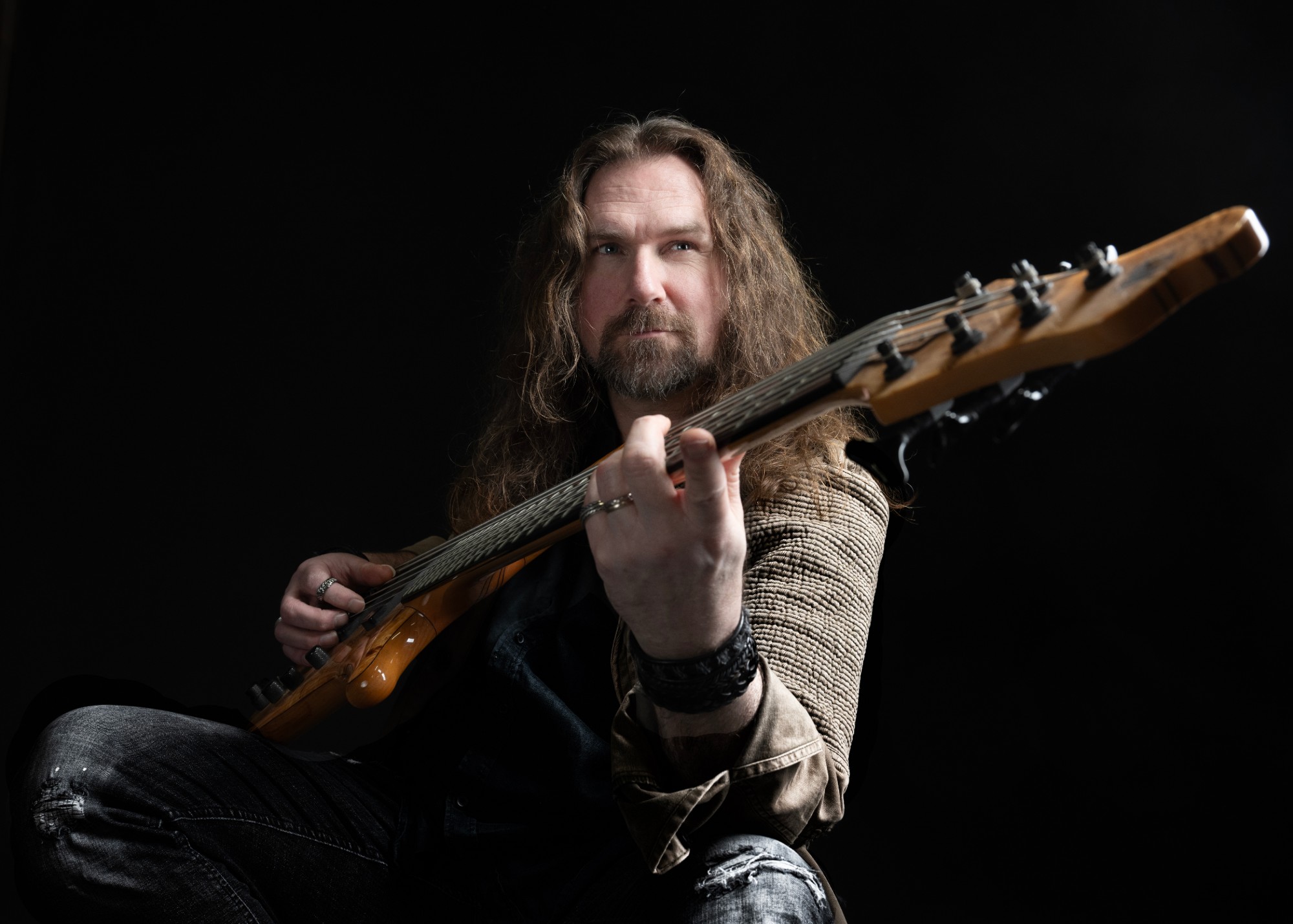
Photograph: DCH Photography
Interview: Jordi Amela
Kristoffer Gildenlöw was the bassist of Pain of Salvation from 1994 to 2006, and has recorded and toured with artists from around the world, including Neal Morse, Damian Wilson, Lana Lane and For All We Know. He released “Rust” under his own name in 2012, followed by “The Rain” (2016), “Homebound” (2020), “Let Me Be a Ghost” (2021) and “Empty” (2024).
On 29 May 2026 he released “[Humanised]” on New Joke Music: nine tracks and 45 minutes. We talked to him about how a song is born, his relationship with his brother Daniel, the imperfections he looks for in instruments, two chords that carry an entire song, and how hard it is to make a living from music today.
You started out playing the piano, then became interested in drums before eventually studying bass. Today, you’re a singer, composer, producer and multi-instrumentalist. When a new song begins to take shape, which side of you takes the lead? The pianist, the bassist, the singer, or someone who no longer thinks in terms of individual instruments, but simply in terms of music?
It’s very different each time and that’s why I like to play different instruments and look at music from different perspectives.
Sometimes an idea just pops into my head, usually when at an inconvenient location, far away from my studio or even an instrument.
And sometimes they come as I play around on an instrument. A certain chord, melody or sound triggers something in me that will eventually lead me further towards an idea that might become a song. I see myself more and more as a general musician but bass guitar will remain my main instrument.
You joined Pain of Salvation at just sixteen, playing in a band led by your older brother, Daniel. In a recent interview, you mentioned that you initially questioned whether you were good enough to be there. When did you begin to feel that you had found your own musical voice? And how did growing up alongside a musician with such a strong artistic personality influence your search for your own identity? Did it help you discover who you were, or make that process more difficult?
I’m still searching.
As with so many things, I still don’t know exactly who I am and I’m constantly searching and digging deeper and deeper.
As for standing in the shadow of my brother… it’s usually other people comparing us and constantly facing me with this.
I’ve never intended to sound anything like him or try to be as he is… in anything.
Music is not a competition.
You’re either good enough for a listener or you’re not and that’s all up to them.
I can only try to be better than the person I was yesterday and if I can’t be better, I at least try to be different.
And trying different music styles and dynamics throughout my album is a way to find myself… although each album distinctively does sound like me. So I guess I’ve been here all the time but there are so many sides of me, it might be tricky to find the core within all the fuzziness.
You’ve spoken openly about how painful your departure from Pain of Salvation was, but also about how, over time, you and Daniel managed to rebuild your relationship as brothers. Twenty years on, what has that experience taught you about the difficulty of separating family relationships from professional decisions? Looking back, is there anything you would handle differently today?
Well, first of all, we always managed to keep family and music separated and we never had any bigger arguments or drama within the band.
I think it was the “break-up” itself that made us overreact to some things and feel things more intense than maybe needed.
What I’ve learned, but probably more from maturing and gaining more experience in general, is that you can have different approaches to the relations within a band. Communication is everything and ego is nothing!
There will always be one or two people who are the main writers within a band and how you go about with this, is very important.
How do you create the best creative situations for these people, where they can get the right amount of freedom yet the right amount of push back and feedback and how do you get everyone to feel as important in the band?
We were just kids and walked down the road with what we knew.
I’m sure we would have done things differently now but… also that is part of life.
You live and you learn.
With DIAL, and later with RUST, you began revealing a very different side of yourself from the musician audiences had come to know. When you started writing your own material, did you discover that you had things to express which had never quite found a place in the bands you’d played with? Can you remember a particular composition that made you think, “Yes, this is the music I really want to make”?
I never really thought I’d make music under my own name like this.
At that point I had done the band-thing for many years (including DIAL) and wanted to make something without compromises or discussions or thinking about a certain instrumental line-up.
So I started making music with the idea of building up some sort of band once I had most of the songs down. A new prog-band.
I didn’t see myself as the singer at all.
But my heart and soul wanted to get something “out of the system” first and most of the songs became darker and more introvert.
So I split up the music into two “projects”, the heavier prog rock/metal on one side and the more introvert on the other.
And since the softer songs were so personal to me, I couldn’t let anyone else sing them, really.
And from that moment on, I just kept on making music. I never really composed songs earlier on but I crossed some sort of point where things just started flowing… and it’s been like that ever since.
For RUST, you brought together several guest musicians. That’s an interesting choice for someone embarking on a solo career, especially considering your own abilities as a multi-instrumentalist. What were you looking for in those other musical personalities that you couldn’t achieve on your own? And how do you decide when a song needs another musician’s interpretation rather than your own?
These were quite specific instruments that I either couldn’t play or didn’t think I was good enough at.
As I mentioned earlier, I was at a point where I didn’t want to compromise and didn’t want to get stuck in a certain instrumental line-up.
So I brought everything I wanted and needed without ever thinking I might ever play any of it live.
I’m also a fan of musicians like Mike Oldfield, who are using different instruments and sounds to layer the musical landscape. I like to work that way too and I’m always looking for new sounds to use. [humanised] is the first album where I’m much more rock-band oriented in my instrumentation.
You’ve worked with Pain of Salvation, Kayak and numerous other artists as a session musician, often in situations where your degree of creative freedom has varied considerably. Has working with another composer ever fundamentally changed the way you approach a song? Is there a particular musician who taught you something that you subsequently brought into your own work?
I’m always learning from others, trying to become better at what I do as a musician and as a producer… and even a human being.
I can’t really name a person or a moment where I had some sort of “eureka-moment”. Just constantly learning from others and getting inspired.
In The Rain, you explored the inner world of a man living with dementia. From a purely musical perspective, how did you approach the idea of a mind gradually losing its memories? Did you experiment with recurring melodies, fragments of familiar themes, silence or structures that slowly unravel? I’m particularly interested in how you translated such an emotional and complex subject into musical decisions.
I always start with the music and the music leads the way for the lyrics. So I was bouncing around ideas and themes to write about. One idea I had was to write about dementia in one way or another.
There’s something immensely sad about this illness, where a person can simply just disappear right in front of you. But I couldn’t really fit a song about dementia into the other ideas that I had. They were more memory-like stories about certain moments or periods in life.
And that, together with me working out musical ideas into several parts, brought me the idea to use dementia as a transportation between the different memories.
Using rain and clouds as a metaphor for dementia, as something that comes and goes and creates confusion, disillusion and disorientation and then the clouds go away, ever so briefly, and on a clear day the memories return and you can reflect on your life… only to be hit by the next raincloud.
So I managed to work intensely with the subject of dementia throughout the album, without even naming it, and also lots of other life-related subjects along the way.
And just like with “Let Me Be A Ghost”, I did a lot of research on the subject. Reading medical studies, reading and watching interviews with people with dementia and people connected to people with dementia. I wanted to understand it more and look at it from all angles before writing about it.
When recording The Rain, you used the organ of the Jacobikerk in Utrecht, which dates back to 1509, recorded in the church itself. Today, technology allows us to reproduce almost any instrument digitally. What is it about a real instrument, the acoustics of a particular space or even the limitations of an old instrument that technology still struggles to capture? Have you ever found that the place where you were recording actually changed the music itself?
I use synthesizers and samples all the time but I do prefer to use real instruments as much as possible.
Not because they sound better but because they usually sound a bit worse. Samples are often perfect and sometimes that works and sometimes it just sounds too clinical and “dead”.
I’ve only been to one church, where the organ and the church sounded so incredibly good, that you thought you were in a perfect studio environment. But even then, you had people around you making noises, benches cracking, wind swirling around. I wanted you to feel like you were in the church with us and that’s hard when using a perfectly recorded and sampled organ sample.
I love the imperfections in music. Like the rest of our lives… nothing’s perfect and that’s what makes life, and makes us feel alive.
So I was very lucky to find someone who played organ in a church, that could help me out. I created a portable recording facility and some very long cables.
But this is how I look at most instruments and that’s why I rather have a guest musician play an actual accordion, where you hear the air pump and the keys click, rather than using a perfectly sampled one. Or a music box, or a trumpet… It’s these perfect imperfections I’m looking for.
Your music can be extraordinarily complex, yet some of your most moving passages are remarkably simple. When arranging a composition, which is more difficult: finding the right notes or knowing which notes to leave out? Has your experience as a bassist influenced the way you think about silence, space and the relationship between instruments?
When writing something complex – the challenge is to make it sound simple. Focus on the melody and the important part of the song. I’ve never liked show-off complexity or “make it difficult just to make it difficult”. There are enough of those bands and artists out there anyway.
When writing something simple – timing, touch, detail, dynamics, timbre, tone… everything needs to be just right because it’s all in focus.
I can record something quite complex and be happy with it after 2-3 takes… yet spend 30 takes on something seemingly simple, just because one note was slightly off. It might not be that important to the listener in the end but it matters to me.
And yes… less is more. When I’m done writing a song as a demo, I look at everything again and remove every instrument that doesn’t add to the song. If it’s just filling up or it’s an extra take… away it goes.
I wouldn’t say that I’m a minimalist in any way… ’cause some songs have well over 100 tracks… but if something doesn’t add value to the song (or worse: it adds noise or makes the production sound muddy), it has to go.
And I do this with every song and every album.
You’ve mentioned that, for a long time, you didn’t really think of yourself as a singer. Yet on [humanised], you’ve taken on increasingly demanding vocal performances alongside your instrumental work. What helped you overcome that uncertainty? Is there a song on the new album that you simply wouldn’t have dared to sing ten years ago?
I still don’t consider myself as a lead singer really. I’m just doing the best I can.
But with 5 albums out and 14 years of doing just that – stepping up to the mic – I thought I’d try to raise the bar for myself singing wise and sing both higher, more aggressively and more complicated vocals. I guess I just stepped in with both feet to see where it would take me. If it didn’t work, I could always skip a song or rearrange it or something.
I’m still not happy with my vocal performances on the album and some things sounded quite differently in my head than what came out of my mouth when recording but I guess that’s life too.
This whole album has been a step into new territory for me as a songwriter, a musician, a singer and a producer. Only as a bass player did I feel comfortable in the studio, the rest was just “moving on”, hoping the end result would come as close as possible to the idea in my head.
You’ve explained that you generally write the music first and the lyrics come later. That suggests that, in some way, a composition already carries an emotion before you know exactly what the song is going to be about. Has a piece of music ever led you towards a story you hadn’t intended to tell? Can your own songs sometimes surprise you by revealing something about yourself that you hadn’t consciously recognised?
All the time!
I keep on writing lyrics while still recording the vocals. Sometimes a word doesn’t work out or doesn’t feel right, so I keep on changing them and sometimes even re-recording them after I’ve started mixing. So it’s a continuous progression.
And sometimes it’s just one of those words that changes everything. The mood of a song or the whole story of the album, forcing me to rewrite other songs as something different and better just popped up. And I like that, even if it costs me more time and effort.
If something can be done better, then do that. Don’t be afraid to change and don’t feel stuck and overprotective about what you’ve already created. This is also the contemporary part of music, because even if the album is done and released, you can still keep on changing it for live shows. The music can still evolve and become different over time.
Music is what comes first to me and I often say that the music speaks to me and wants me to say something. That’s what becomes the lyrics and once we start that journey together, we can both move around a bit and change. Change the music to fit the lyrics, change the lyrics to fit the music. It’s more like two different entities working together to grow into each other, than one “whole”.
On Let Me Be a Ghost, you explored some particularly dark psychological territory. With Empty, your perspective widened to examine human behaviour, even imagining the viewpoint of a creator observing his own creation. Does writing from that kind of distance allow you to express thoughts or feelings that might be harder to address directly? And have any of the ideas you explored on those albums changed for you since their release?
Hard to address, more like you don’t really get around to talk about these subjects very often. They’re on my mind and they occupy my thoughts and curiosity and therefore I find them interesting to write about.
Sometimes they help people with their own thoughts, sometimes they strike up a discussion… it’s all good. Let’s not look away from different ideas and thoughts but let’s talk about them.
I still stand with my lyrics and albums. You live and you learn and your perspective on life and the world will constantly change but I haven’t written anything that really makes a statement from a personal perspective. Certainly nothing I don’t fully believe in.
My way of writing is more describing a situation and letting the listener reflect on that. Do they recognize themselves in this situation? How do they feel about it and will it change the way they look at it? It’s up to them to decide what to do with the information.
[humanised] brings back some of the heavier elements of progressive rock while retaining the emotional sensitivity of your previous solo work. On “The Almosts”, for instance, you build a remarkably layered composition around just two chords. How do you balance musical complexity with simplicity? At what point do you know that a song has everything it needs, and that adding another layer would actually weaken it?
Trial and error.
I’ve scrapped far more ideas and songs than I’ve ever released. I have over 1000 ideas on my memo-recorder. I don’t delete them but most of them are just bad ideas. Once they sounded interesting, I recorded them in some way (mostly singing or humming or playing guitar into the memo-recorder) and came back to them later only to discover that the magic was gone and there was but a sad little crappy idea left. And this happens all the time. Then you have to learn how to let go.
Recording “The Almosts”, I was stunned about the song just turning into two chords. This can’t be! There has to be a pre-chorus, a chorus… some sort of change… but every idea I added only made the song sound less. Intensity disappeared, feeling disappeared and it just became less. So you go back to where it sounded good and try out other ideas. In this case, I just kept on playing the two chords and that’s what the song needed.
“Before I Fail Asleep” was completely re-arranged three times before I found the right formula. It’s a very complex song and that’s what it sounded like in the beginning – a long “hey look at me, I can make difficult music” kind of song and I didn’t want that. So I cut lots of ideas, rearranged, put some of the difficult parts way in the background, changed the dynamics etc.
Just keep at it until it sounds good and don’t be afraid to cut ideas or even hours of hard work, if it doesn’t fit the song. The song itself always has to be the number one priority. Not you as a musician, not the cool licks, not the flashy production… the song.
“Binary” appears to explore the increasingly blurred boundaries between human emotion and artificial intelligence. I find it fascinating that technology can provide a way of examining something as deeply human as our capacity to feel. What drew you to this subject? And do you think our emotional understanding of one another is developing at anything like the same pace as the technology we’re creating?
AI is a very hot topic right now and I was looking into different ways to set up the album around this. But I also realized that a whole album about AI would probably age very quickly and turn out futile in just a few years from now.
So I went into the subject of what it is to be human. What makes us human and what problems do we encounter when trying to be human? What is right or wrong? Is there a right and wrong? How would we measure and label right and wrong? Who gets to decide or is there any science to it… is it religiously decided?
And with all discussions going on in the world today on the matter – whether it be religious beliefs and life choices, neurodivergence, LGBTQ+ – it sure seems like our emotional understanding has hardened significantly over the past years. We’ve seen big steps in polarisation and loss of empathy. This usually leads up to a big explosion, the fall of empires and great wars.
So my take on AI took more inspiration from Wall-E and Big Hero 6, where an AI grew actual feelings and fell in love with the human who’s been chatting with him for years. Instead of focussing on the potential AI-disaster that lies ahead of us.
You’ve also devoted considerable time and energy to charitable music projects, including Pass The Torch, a song you wrote and produced to support elephant conservation, and Breaking The Chains, a project you coordinated to raise awareness and funds to help abused children. What motivated you to become personally involved in these causes? Looking back on the work behind those projects, with so many musicians brought together, did you feel that music had achieved something tangible that might have been difficult to accomplish in another way?
Music is a huge force of connecting and uniting humans. One that defies borders and obstacles we usually put up for ourselves. Just look at bigger festivals, where people of different nationalities, race, religion, sexual preferences and ages come together as friends to enjoy a weekend of good music. It’s an amazing feeling. At a music festival you don’t see strangers, only friends you haven’t met yet.
I’ve always been doing things for charity. Most of the time it’s donating money and sometimes I manage to actually put in some hours of hard work into it as well. From cleaning up the neighbourhood, helping elderly, walking door to door collecting money or even starting up some sort of musical project. I think it’s the right thing to do. If you can help, then do so – if you don’t have the money, then maybe you have the time.
And many times what a charity organisation needs the most is exposure. That people know they exist and can be reached. That was the main goal for “Breaking The Chains”, to make sure ‘Bikers Against Child Abuse’ got more attention so that they can help more children.
Today, musicians can record and produce entire albums without relying on a major record company or an expensive studio. Yet reaching an audience and finding opportunities to perform live remain difficult, even for established artists. You’ve recently spoken about the challenges of finding gigs and working with booking agents. What concerns you most about the music industry today? Are we reaching a point where creating good music is easier than persuading people to give it the time and attention it deserves?
It’s always been difficult to be an artist. Even back in the days you had to be good, you had to be talented, you had to be at the right place at the right time and be seen and heard by the right person and you had to have a record label that believed in you etc. etc.
Those times have changed quite a bit and it’s easier for independent artists (like myself) to create complete albums and potentially reach millions of people through social media and streaming etc. Meanwhile the rest of the music world has changed quite a bit as well.
Venues have become more commercial and don’t take chances with smaller bands or bands that don’t fill the floor, as they need to pay staff and all other administration that’s been added throughout the years. Record labels take less chances and spend less of a budget on their bands.
At the same time, music has lost lots of its value through streaming and downloading. Consumers spend less and less money on music, yet get more and more music. It’s an inflation of the whole value of music and that’s one of the biggest problems we have these days. Music has become so accessible that it’s not worth spending money and time on anymore.
And adding to this, music in culture has also changed quite a bit. Music has often been related to a certain movement or group of people throughout time. It’s been the younger generation who’ve brought new music and ideas into the world and it’s been a part of their identity in the society. Punkers, anarchists, metal heads, hippies, synth, emo, grungers, disco queens, skaters etc. Each group had a music style, a dress code, accessories etc.
This isn’t the case anymore. For the past 20 years, music and society has been quite faceless and bland when it comes to identifying one another. And therefore music has also lost its value as a part of your identity.
When you joined Pain of Salvation, you were only sixteen and your musical life was just beginning. Since then, there have been albums, tours, collaborations, successful projects and others that never quite worked out as planned. If you could meet that sixteen-year-old Kristoffer just before his first concert with the band, what would you tell him? And, perhaps more interestingly, what would you deliberately choose not to tell him, because you’d want him to discover it for himself?
I think I’d tell him to be more social and make more connections with people, because that’s how you get around in this business. You know someone who knows someone and all of a sudden you get the call. I’ve never auditioned for any gig. They either know me or someone recommended me and that’s enough.
I’d also tell him to say “no” more often and be a bit more selective with whom to work with. And I’d tell him to stay curious and keep on learning. Talk to people and ask questions. Also to start earlier with playing bass with a pick and using effect pedals.
And to calm down, be more easy going and enjoy the ride, because every moment you get to spend playing music live, in the studio or in the rehearsal room… is a blessing that you won’t appreciate fully until afterwards.
Other than that… just go out and have fun! Life within music can take you anywhere and it’s often with unexpected turns and twists. So hold your hands up in the air and enjoy the roller coaster that is musicianship.
You’ve spent more than thirty years making music, moving from interpreting other people’s compositions to creating deeply personal albums of your own. Is there anything you still haven’t dared to attempt musically? A composition, an idea or a project that gives you that same mixture of excitement and uncertainty you probably felt when you were first starting out?
I wouldn’t say “dare” but there’s a lot of things I’d love to do or try out. Usually it’s a matter of money or connections keeping me from it.
Like working on film music or with an orchestra or conducting a massive live show with visuals, light, pyro etc. But also going on tour with a big act, playing bass with other great musicians.
Who knows… my life isn’t over yet… I’m waiting for that call… just need to be a bit more social and go out and connect with more people.