
Today it’s the turn of another keyboard instrument that became an icon of classic Progressive Rock, especially in the hands of the brilliant Keith Emerson of Emerson, Lake & Palmer (ELP): the Moog modular synthesizers.
The history of musical synthesizers is a little hazy, because there’s no single, unambiguous, universally agreed definition of what is or isn’t a synthesizer. From the early 20th century onward, electrical or electronic devices that generated sound started appearing, such as the Telharmonium (1897), the Ondes Martenot (1928), the Theremin (1928) or the Trautonium (1930), but these aren’t usually considered “synthesizers” in the modern sense of the term, rather ancestors of the concept.
Some consider the Hammond organ (from 1934) an “electro-mechanical synthesizer”, but it’s not usually included on the list of synthesizers either.
The instrument that many do already consider the first electronic synthesizer is the Hammond Novachord from 1939, an impressive instrument well ahead of its time, which used subtractive synthesis (the method almost every synthesizer of the ’60s and ’70s would use) and was, surprisingly, fully polyphonic — something that wouldn’t be achieved again (in any commercially viable way) for another 36 years! It was highly complex and extremely expensive, and like every electronic device of the era, it ran on valves (vacuum tubes), which is why some people also refuse to consider it a genuine modern synthesizer, reserving that term for instruments already running on transistors.
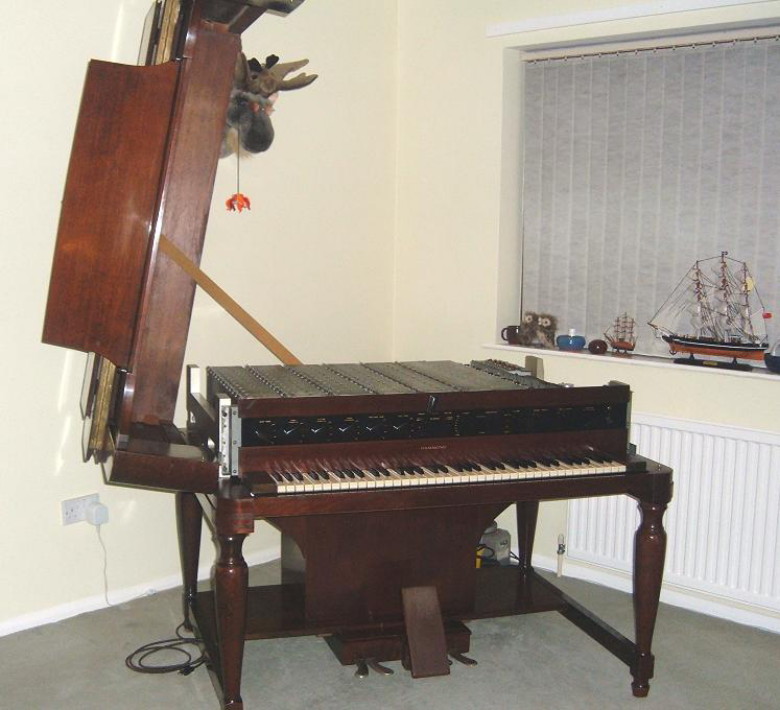
The Hammond Novachord from 1939
The first true transistor-based synthesizers were developed by Americans Bob Moog and Don Buchla (independently of each other) in the first half of the ’60s, building on concepts devised in 1960 by German Harold Bode. Both Moog and Buchla opted for subtractive synthesis and developed their models practically in parallel, and while the operating principles were very similar, and both built modular systems, Buchla’s instruments were more experimental, and in the end it was Moog’s approach that prevailed and achieved greater success. An important limitation, shared by both, was that the instrument was monophonic — meaning it could only play one note at a time, no chords.
There’s some debate over which of the three — Bode, Moog or Buchla — should be considered the true father of the modern transistor synthesizer, but Moog is usually the one who gets the title. Moog completed his first synthesizer in 1964, and the first commercial units went on sale in late 1966.

Moog’s first synthesizer from 1964 (not yet a commercial product)
The instrument was very expensive for most musicians (starting at $4,000 in the money of the time), and the first units to hit the market tended to be owned by producers or recording studios. By 1967 it had already appeared on a few records, adding sonic touches to certain tracks, but nobody yet saw it as a lead instrument, let alone something practical to take to live concerts.

The Moog modular I-C from 1967, with its keyboard and ribbon controllers

The Moog III in cabinet C or P
In the early years, it was built in 2 cabinet types, each with 3 levels of complexity: the C series cabinets (wider, stackable units, geared more towards static studio use) and the P series (more square-shaped, designed to be transportable), with a number I, II or III before the letter denoting the complexity level — I being the simplest and III the most complete. While each had its standard configuration, given the modular concept and the fact these were expensive instruments, they were often custom-built to order according to what the customer wanted, meaning each musician’s instrument tended to differ slightly from the next.
The Moog modular became much more widely known in 1968, when Wendy Carlos released the album “Switched-On Bach”, a collection of J.S. Bach pieces performed entirely on the Moog synthesizer, which won 3 Grammy awards and was highly successful. Since the instrument was monophonic, the album involved an enormous amount of work layering each track or fragment, recorded separately.
When Keith Emerson heard “Switched-On Bach” he was fascinated by the instrument, and managed to borrow the one belonging to Mike Vickers, keyboardist of Manfred Mann, who owned the first unit to arrive in the UK; he tried it out with his band at the time, The Nice, and became the first person to dare use it in live Rock concerts.
When he teamed up with Greg Lake and Carl Palmer in 1970 to form ELP, he knew right away he wanted one, and managed to buy an I-C unit that Moog had built specifically for a demonstration concert. This one (referred to internally as the I-Ca) had several differences from the standard I-C, and included an unusual module (external at first, but later incorporated into the cabinet itself once the synthesizer was expanded) that allowed 6 sounds to be pre-programmed so they could be recalled instantly, without touching any cables or controls — what’s known as presets. That said, this didn’t mean the instrument had “program memory” (which was still about 8 years away) — these 6 sounds had to be pre-programmed at the factory.
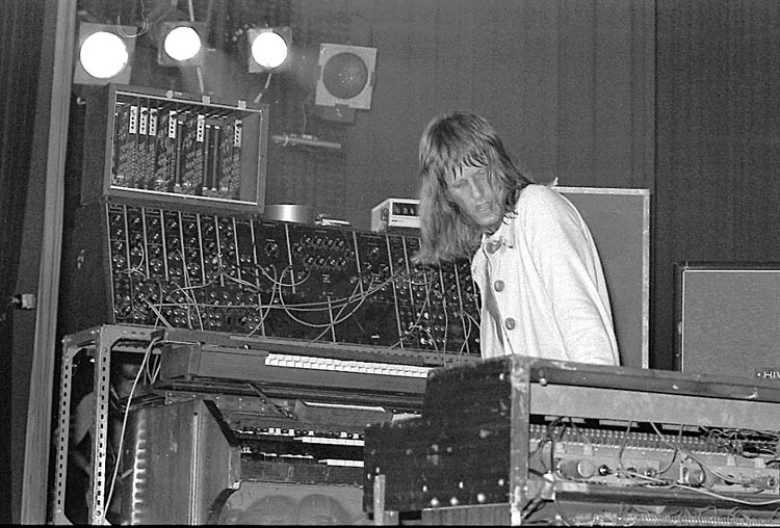
Emerson with the Moog I-Ca before it was expanded. The box seen on top was the external module allowing 6 pre-programmed sounds
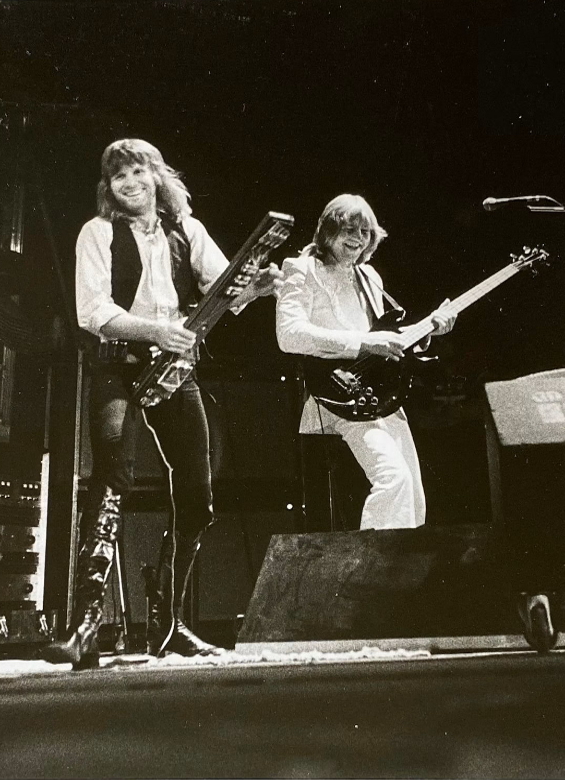
Emerson playing the ribbon controller (Greg Lake plays a Gibson Ripper bass)
From then on, Emerson became a close collaborator with Moog, contributing to the instrument’s evolution, and quickly kept expanding his I-Ca, which before long grew even bigger than a III-C.
One interesting feature offered by Moog was the ribbon controller, where sliding your finger along the ribbon produced continuous pitch-bending sounds using a technique called “slide”, while the keyboard controller also included the portamento effect, which does practically the same thing but only between two consecutively played keys, sliding gradually and continuously from one note to the next. Another interesting element was the sequencer module, which allowed simple note sequences to be programmed and looped, and which proved essential for more electronic Prog.
A common problem affecting all synthesizers of the era, though, was that temperature changes affected the oscillators, altering the frequency of the notes produced, which meant they’d go out of tune — a problem known as “pitch drift” — and they had to be retuned fairly often, even mid-concert.
The various modules were connected to each other using cables in the style of old telephone switchboards, called patch-cables, and connecting them in different ways (different signal paths), together with the settings of every control, determined the instrument’s final sound. The sheer number of cables undoubtedly gave the general public an impression of great complexity. But the truth is that once you understood the underlying principles, Moog modulars were fairly intuitive instruments, and conceptually quite simple.

Emerson with his already-expanded Moog in 1974 (on top of the Hammond C-3 organ)
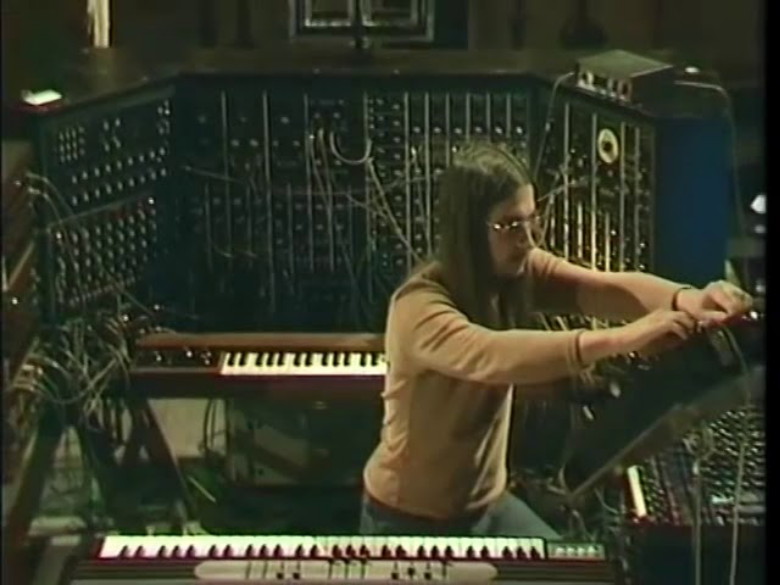
Chris Franke of Tangerine Dream in 1975. Behind him you can see his Moog modular, a custom unit based on the III-P. In the foreground is an Elka Rhapsody 610 (a “string machine”), and in his hands he’s working an EMS Synthi A
In the book I explain in detail how a modular synthesizer like the Moog works, and the different modules it’s made up of and what each one does — I won’t get into that here, since the article would run far too long. If you’re interested, I invite you to buy the book!
Patch-cables are a thing of the past by now, but the term “patch” has survived to this day, referring to a synthesizer’s full set of configurations (signal paths and every parameter setting) that result in a given sound. On modern synthesizers, different patches can be saved and recalled whenever we want to play them.
From 1971 onward, Moog released simpler models called the 10, 12 and 15, and from 1973 the more complete models were renamed the System 35 (equivalent to an updated I-C) and the top-of-the-range System 55, inspired by Emerson’s own instrument.
Moog kept building modulars (always analogue) until 1981, but the company failed to adapt when digital technology burst onto the scene, and it eventually had to close down in 1987; the rights to the Moog name were acquired by Don Martin, who also manufactured a few instruments under the Moog name (in fact, during the ’80s and ’90s there was a considerable mess involving the various companies tied to the Moog name, which could easily fill an entire article on its own).
In the late ’90s, though, seeing a certain nostalgia and market resurging for classic analogue instruments (Minimoogs and other original Moog products were fetching very high prices on the second-hand market), Bob Moog managed to reclaim the rights to the brand, and in 2002 he reopened Moog, launching a renewed version of the Minimoog called the Voyager; besides releasing a few other models, in 2015 they also went back to building modulars, improved replicas of their ’70s counterparts.
In 2014 they announced a very limited production run of a recreation of Emerson’s own instrument, called the EMMS (Emerson Moog Modular System), at a jaw-dropping price of $150,000.
Other users of the Moog modulars include mainly Electronic Prog musicians like Tangerine Dream, Jean-Michel Jarre, Vangelis or Klaus Schulze, but also some more rock-oriented players like Ken Hensley of Uriah Heep, and more recently Erik Norlander, who has often taken a huge Moog modular out on tour.
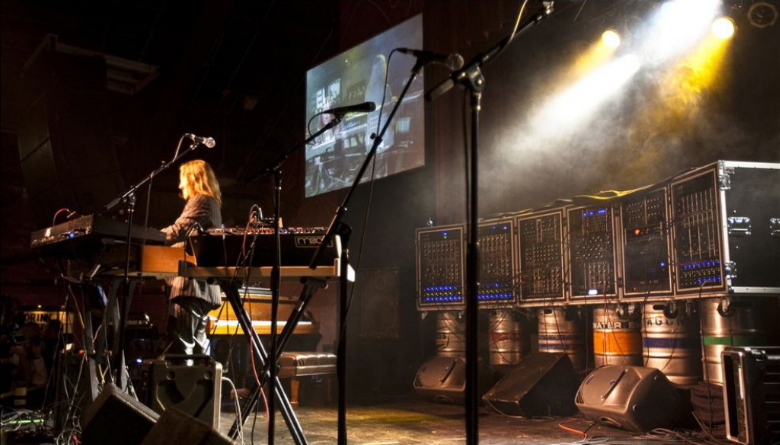
Erik Norlander in concert in 2010; behind him you can see the 6 cabinets making up his Moog modular
In future articles I’ll talk about other iconic Moog products.
Until next time!
Gerard Bassols
If you enjoy this topic, remember you’ll find much more information in the book “Los Instrumentos Musicales del Rock Progresivo; Guía Ilustrada”, available at this link. Have you read the readers’ reviews yet?
https://www.amazon.es/instrumentos-musicales-Rock-Progresivo-ilustrada/dp/8413318645
And if you’d prefer, it’s also published in English:
https://www.amazon.com/Musical-Instruments-Progressive-Rock/dp/8413385997