
Post-rock
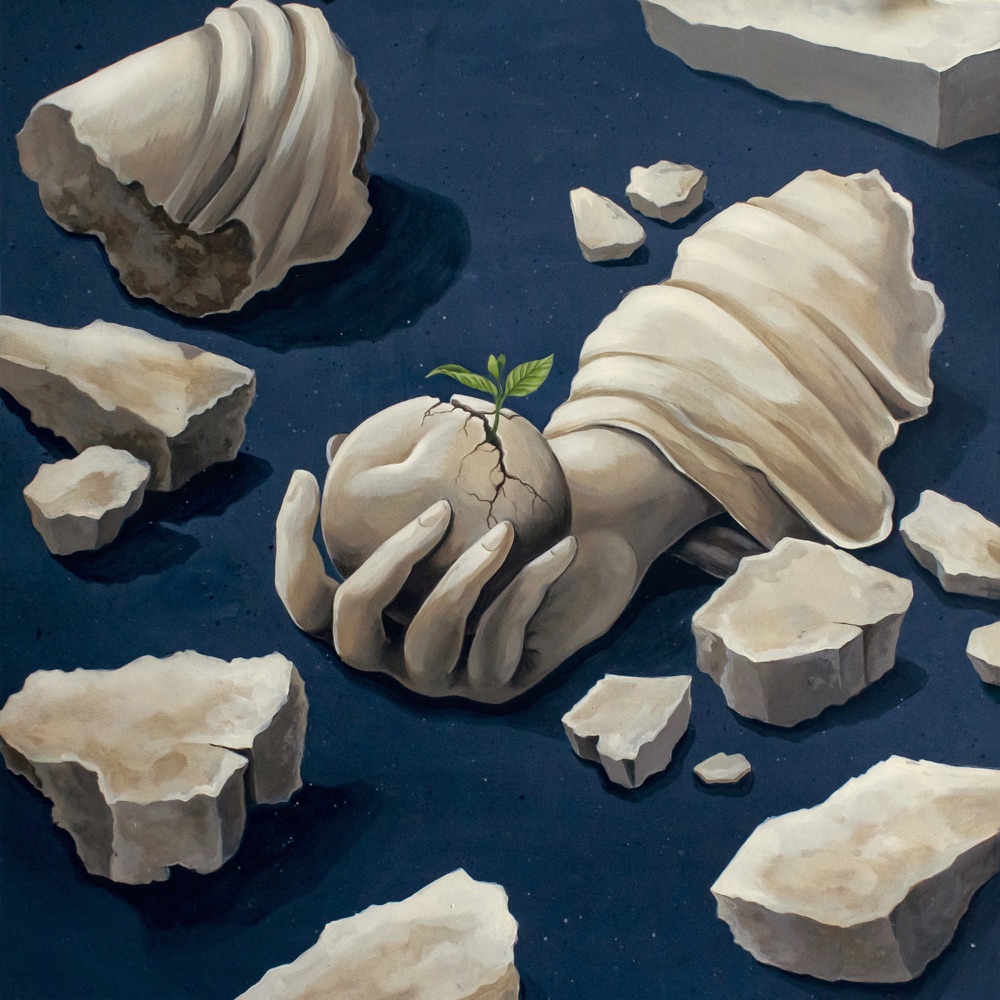
Toundra released “Siete” on Friday: seven tracks and forty-one minutes, arriving four years and eight months after “Hex” and put out by the band themselves. It was mixed at Ultramarinos Costa Brava in Sant Feliu de Guíxols, with Santi García at the desk and Víctor García mastering. The cover is a painting by Mercedes Bellido: among the pieces of a fallen statue, a stone hand holds a cracked sphere with a green shoot coming out of it.
It is the first album without Esteban J. Girón. The guitarist, a founding member, left in January 2025 for personal reasons, after a year away from view and with every concert cancelled, and the other three were left working out whether there was anything to carry on with. “At first the general idea was to take a break,” says David López “Macón”. What settled it was not a decision but the work: “As we started writing new pieces, we realised it was daft not to keep the band going. The new songs still sounded like us and they belonged to us.”
The spur was Jorge García, who has come in on guitars and synthesisers and who had been around the band for years: he had made videos and done design work for them, and he has been a friend of Macón’s for more than twenty years, going back to ADRIFT and later El Páramo. Synthesisers and analogue electronics have entered Toundra’s vocabulary with him. Alberto Tocados on bass and Álex Pérez on drums complete the line-up.
“Siete” is also the first record they have put out without a label, after leaving InsideOut, and they explain it without a word of reproach: they say they always had creative freedom there and that what has changed is the arithmetic. “There was a time when a label could take on, I don’t know, the recording costs, say. But these days… A label is there to put your record out, and not much else.” And they add the date that qualifies it: “If they had suggested we self-release in 2012, with only three albums out, it would probably have done the project real harm. But now, with what we have behind us, independence was the most natural way to carry on.” Ditto Music handles distribution.
Santi García did more than mix it. The band credit him with the change of format: he was the one who pushed them to simplify the structures, shorten the songs and rein in their habit of stringing one swerve onto the next. “The idea was to try to make simpler songs, shorter, with fewer changes,” they say, not entirely convinced they managed it. The longest track on “Siete”, “Eina”, runs seven minutes eight; on “Hex” the first side was a single twenty-two-minute piece.
Something else came out of the studio. “30960” refers to the lighthouse at Sant Feliu de Guíxols, the town where the band have stayed every time they have gone in to record over all these years. “We haven’t had it tattooed, the way some people do, but dedicating a song to that place is almost the same thing.”
The album can be streamed in full for free on Bandcamp and the platforms; the digital edition is ten euros and the vinyl twenty-three on the band’s own site. The tour takes in twelve cities between this October and March 2027 and opens on 23 October in Barakaldo. They play Barcelona on 11 December at Razzmatazz 2, as part of the venue’s anniversary.
Text by Marçal Bonastre