
There was a time when finding a particular record wasn’t a matter of typing a few words into a search engine. If a band had no distribution here, you had to know where to go, ask around, order it, and wait. In Barcelona, for many years, one address that inevitably kept coming up among progressive rock fans was Pan y Música.
The shop was born in the late seventies, and its scope was initially broader than just progressive rock. You could find avant-garde music, electronic, Krautrock and other material that rarely had a place in mainstream record stores. Over time, though, Pan y Música became increasingly identified with progressive and symphonic rock.
The location most people remember was on Carrer Ros de Olano, in Gràcia, very close to Fontana. Through the eighties, and especially the nineties, it was a small meeting point for a scene that existed almost entirely on the margins of the mainstream music industry.
That period inevitably brings up the name Esteve Vendrell, usually referred to as Esteban Vendrell in Spanish-language publications. Around him, Pan y Música became far more than just a record shop. It imported material, distributed publications, kept in touch with foreign labels, ran a mail-order operation, and would eventually get involved in organising concerts too.
Pan y Música’s shelves could pack a good chunk of the European progressive rock map of the time into just a few metres. There was IQ, Pendragon, Pallas, Jadis, Änglagård, Eloy, The Enid, Henry Cow, Popol Vuh, and Italian outfits like PFM, Banco del Mutuo Soccorso, Osanna and Le Orme. An international guide dedicated to progressive-rock specialist shops already singled out Pan y Música’s catalogue and its stock of Spanish and Italian material.
But framing that story around British or European bands alone would leave out an essential part of it. Pan y Música was also a place where you could find the progressive rock being made right here, often by bands with minuscule distribution who barely appeared in the media at all.
Among those names were Galadriel, Rivendel, and Barcelona’s own Dracma.
Galadriel and Jesús Filardi
Galadriel are one of the bands that best illustrate the survival of Spanish progressive rock through the eighties, precisely when that musical language seemed to have vanished from the current scene.
The band formed in Madrid in December 1985 with Jesús Filardi on vocals, previously of Algor; David Aladro on keyboards, Óscar Pérez on drums and Pablo Molina on bass, all three coming from Dantalion; Manolo Macía on guitars, formerly of Galdalus; and Manolo Pancorbo, ex-The Magic of Fire, also on guitars. From their earliest concerts, Filardi’s theatricality and stage presence were already part of the band’s identity.
In 1986 they recorded the cassette La Escalinata, and in 1988 came Muttered Promises From an Ageless Pond, a record that would go on to make Galadriel one of the reference names of Spanish neo-prog. Filardi has explained in later interviews that in the early eighties he had discovered and bought records by IQ, Pallas, Marillion, Twelfth Night or The Enid in London. That British progressive revival was one of the influences that pushed him to want to build a similar project here.
Galadriel would go on to record Chasing the Dragonfly, Mindscapers and, years later, Calibrated Collision Course. On that last record, Filardi and bassist José Bautista worked with several guest musicians, including Jean Pascal Boffo on guitars and Andy Sears, singer of Twelfth Night, on backing vocals.
What makes this interesting is that Galadriel weren’t simply a band looking back to the seventies. They belonged to that generation who had discovered Marillion, IQ, Pendragon or Twelfth Night, and were trying to prove there was still room for contemporary progressive rock.
And that was exactly the kind of record you could go and track down at Pan y Música.
Rivendel, from San Sebastián
Another name that could turn up among that stock was Rivendel.
The band formed in San Sebastián in 1985 with Toño Cruz on guitar, Josemari Aguirrezabala on bass and wind instruments, and Óscar Belío on keyboards. With Mikel Torés on drums, they appeared on the international compilation Exposure ’88, and developed a sound that referenced classic progressive rock while sitting squarely within the new eighties scene.
Their first album, Manifesto, was recorded in 1990 and released in 1991 on their own label, Lednevir Records. Josemari Aguirrezabala, Óscar Belío, Toño Cruz and Mikel Torés all played on the recording.
1996 brought The Meaning, released on the French label Musea, now with Juancar Pérez on drums. The record contained just three tracks, though very long ones, including the nearly half-hour title composition. The three tracks were sung in Spanish, English and French respectively.
Rivendel are a great example of that Spanish progressive scene that existed, recorded albums and had an audience, but rarely surfaced outside the specialist circuit.
Dracma: Jordi Amela, Jordi Prats, and Barcelona’s Nineties Progressive Scene
And if there was one band that was especially close to Pan y Música geographically, it was Dracma.
The band was born in Barcelona in 1993 around Jordi Amela, keyboardist and pianist, and Jordi Prats, on electric, acoustic and twelve-string guitar. Joining them initially was drummer J. L. Pacheco, formerly of Rara Avis. Jordi Planas, on bass and classical guitar, and Pedro J. Jiménez, a singer who had previously played alongside Pacheco in Hamelin, joined later.
That line-up is, in fact, why people talk about Dracma’s “three Jordis”: Jordi Amela, Jordi Prats and Jordi Planas, names that come up again and again in the band’s early history.
Their first record was Límits. Sources don’t entirely agree on the year — some date it to 1994, others to 1995 — but they do agree it was released on the Italian label Mellow Records, an especially important home for European progressive rock during that decade.
Límits included tracks like “Open Your Gates”, “Answers”, “Felling a Tree”, “Some Faces of a Runaway Rabbitt”, “Visions from the Park”, and the sprawling “The Sect of Ignorance”, running over thirteen minutes. It’s a record firmly rooted in nineties neo-prog, with Genesis and Yes in the background, but above all drawing on more contemporary references like Marillion, IQ or Twelfth Night.
Two years later came the record that probably gave Dracma the most international exposure: A Fine Stormy Weather, released in 1996 on the French label Musea, now with Eduardo Camblor on drums.
It included compositions such as “Beating Life”, “The Mask”, “Inner Castle”, “Arenys”, “Hope”, and the two parts of “Inside Out”. The record runs over fifty minutes and showed a more mature band, capable of crafting long pieces without losing the melodic core that defined neo-prog.
How important that record was within the European progressive circuit can still be seen years later. In an interview published by the Dutch magazine Progwereld, by which point Jordi Amela and Jordi Prats were already working on another project, the interviewer referred to A Fine Stormy Weather as a neo-prog classic, and recalled that the Dracma name had gone on to achieve a certain degree of European recognition.
The band’s story would continue, and there would even be a third planned album, Ubud, before Amela and Prats set off on a new musical chapter. But it’s those first two records, Límits and A Fine Stormy Weather, that best place Dracma within that Barcelona scene of the nineties.
It’s worth remembering this, because when we think of Pan y Música it’s easy to fall into the trap of remembering only the imports. But Pendragon or Änglagård could sit side by side there with Galadriel, Rivendel and Dracma. Progressive rock wasn’t only arriving from London, Canterbury, Sweden or Italy. It was also being made in Madrid, San Sebastián or Barcelona.
Going in Looking for One Record and Leaving with Another
That mix explains Pan y Música better than any inventory could.
You could walk in looking for a specific title and walk out having discovered a Swedish, Italian or French band you’d never even heard of before. Before algorithms, automated playlists and streaming platforms, a large part of these recommendations came from magazines, fanzines, friends, and shopkeepers who actually listened to that music themselves.
One example appears in an article published years later by Alberto Torró. In it, he explained that around 1993 he had mail-ordered Hybris, by Änglagård, from Pan y Música, after the shop itself had recommended the record to him. Torró also described his relationship with Esteban Vendrell and with Sandra, who worked with him, as well as the help Pan y Música had given his fanzine Lunar Suite. This isn’t a testimony we gathered ourselves, but a memory Torró published at a later date.
That’s how things usually worked. Someone had heard a record before you and told you it was worth it. You’d buy it without having been able to listen to the whole thing, take it home, and if it clicked, it would start circulating among other fans.
Catalogues and Mail Order
Pan y Música didn’t rely solely on people who could make it over to Gràcia in person, either.
The shop built up a significant mail-order business. It published catalogues listing the new releases available, some featuring reproductions of the cover art, which allowed customers to place orders from anywhere in Spain, and from abroad too.
An international progressive rock guide from the period noted that these catalogues were updated roughly twice a year, and singled out their presentation for particular praise. At a time when specialist music information trickled in drop by drop, receiving that catalogue also meant discovering what was actually being released.
The internet came later. Pan y Música had an email address and a website back when buying records online was still very much a niche activity. Records survive of the address pany@nexus.es and of an early web presence that predated the shop’s own dedicated domain.
In a sense, the internet was simply a natural continuation of the mail-order business they’d already been running for years.
When Pan y Música Also Put On Concerts
Pan y Música’s story doesn’t end with the records.
The shop also had a hand in promoting concerts and connecting international bands with Barcelona’s progressive rock audience.
One of the most fondly remembered cases is Pendragon, a central band of British neo-prog. On 2 April 1992 the band played at Zeleste 2. Pan y Música is linked to the promotion of that visit, at a time when bringing a band of that kind to Barcelona was a bet placed on a relatively small audience.
The story of The Flower Kings is also particularly interesting.
In an article later published on Rockliquias, Alberto Torró explained that he had suggested to Esteban Vendrell that they try to bring the Swedish band to Barcelona. The idea eventually resulted in a concert at Sala Bikini in 1997, at a time when The Flower Kings didn’t yet have the standing they would later achieve within international progressive rock. According to the same piece, Jesús Filardi, of Galadriel, was also there helping out with that visit.
This helps explain Pan y Música’s real role. Fans, musicians, fanzine editors, promoters, and people who kept in touch with bands and labels abroad all moved in and out of the shop’s orbit.
It didn’t take thousands of people to make a scene exist. Often, a few dozen or a few hundred highly active fans were enough.
Atila and the Recovery of Catalan Progressive Rock
Pan y Música also played a part in recovering historical material.
In the early 2000s it was involved in distributing material by Atila, one of the essential bands of seventies Catalan progressive rock. The reissue of Intención and the recovery of live material brought back into circulation music that, for years, had been very hard to find.
It fit with how the shop had always operated: combining the latest new releases with the recovery of records that explained where the genre had come from.
That Sign on Ros de Olano
Pan y Música also had an exterior look that was hard to forget.
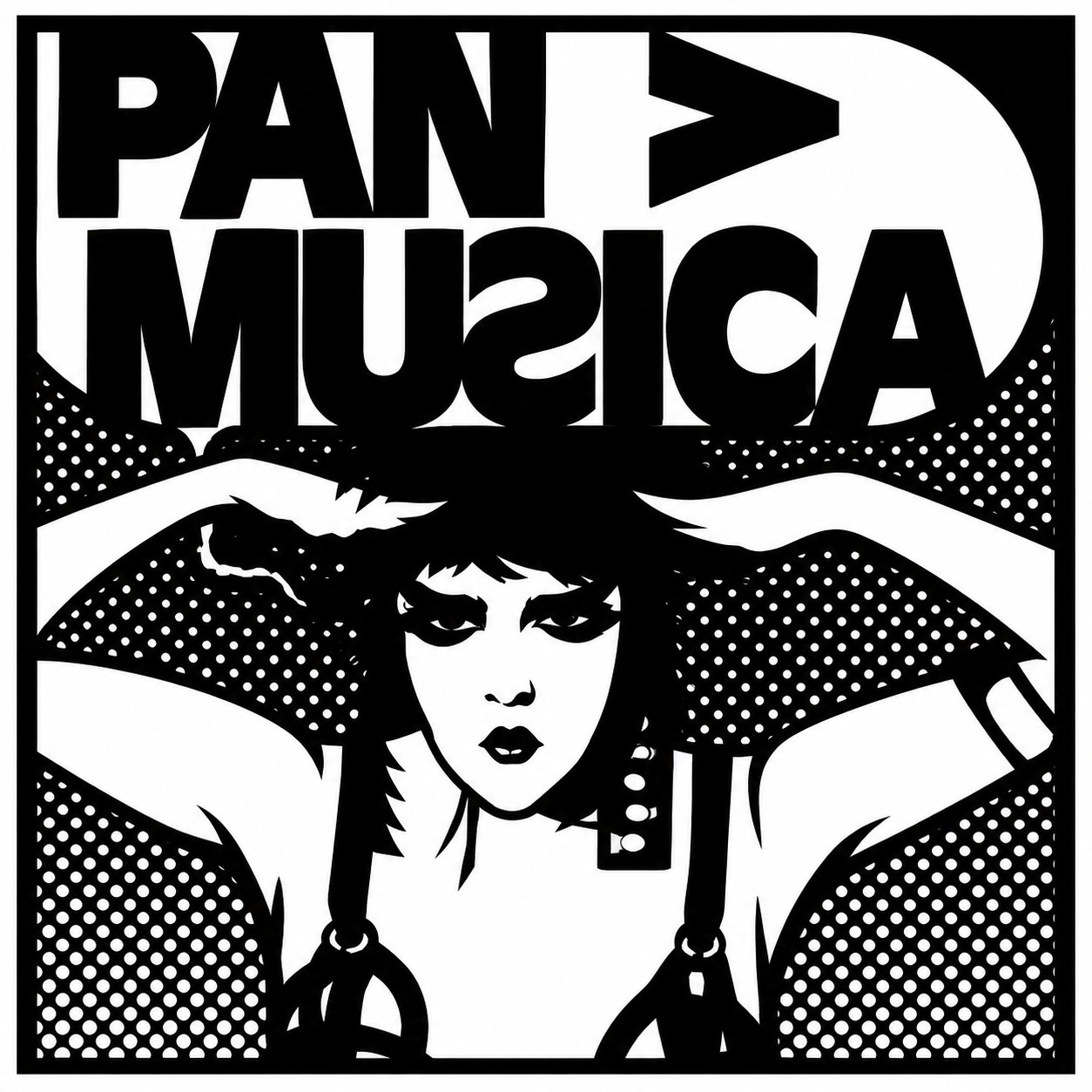
The black-and-white banner on the Ros de Olano shopfront, with a female figure presiding over the design, ended up becoming a small local landmark. The image came from Theda Bara dressed as Cleopatra in the 1917 film Cleopatra.
For a while, even after the shop closed, that sign remained hanging on the street. For anyone who knew what Pan y Música had once been, it functioned almost like an archaeological remnant of a Barcelona music scene that had already changed.
The End of a Way of Buying Music
In the early 2000s the record business began transforming rapidly. Online purchases, downloads, and later the instant access to practically infinite catalogues completely changed the role of specialist shops.
Pan y Música left the Ros de Olano premises and moved to Carrer Sant Elies for its final stretch. Accounts pieced together and published later place its final closure in 2006.
A few accounts circulate about those final years, referring to changes in ownership and the clearing out of remaining stock, but not all of them are equally well documented. In a story like this, it’s best to distinguish between what can be verified and the personal memories that were published years afterwards.
What’s hard to dispute is the place Pan y Música held for a whole generation of followers.
There, you could find the great British bands, but also Galadriel with Jesús Filardi, David Aladro, Pablo Molina or Manolo Macía; Rivendel, with Óscar Belío, Toño Cruz and Josemari Aguirrezabala; or Dracma, with Jordi Amela, Jordi Prats, Jordi Planas, Pedro J. Jiménez and company.
You could walk in looking for Pendragon and discover Änglagård. Buy Dracma’s Límits and, in the same trip, stumble across an Italian import. Order a record by post, pick up a fanzine, or find out that some foreign band was about to play Barcelona.
Today we have instant access to a volume of music that would have seemed impossible back then. Today’s problem is almost the opposite: we have so much to listen to that it’s often hard to decide where to start.
Pan y Música belonged to another world. A world in which discovering a band demanded searching for it, reading, asking around, and sometimes simply trusting the recommendation of whoever was standing behind the counter.
For many years, in Barcelona, one of those counters belonged to Esteve Vendrell and Pan y Música. And for many progressive rock fans, that shop was a gateway to records, bands and stories they probably wouldn’t have discovered any other way.
Esteban Vendrell has since passed away too. But his mark lives on. Tótum Revolútum itself might not exist without his particular way of understanding music: discovering it, sharing it, giving it space, and helping it travel further. He was much more than the person who ran a shop. He was a tireless advocate for the music, and a figure hard to forget within Spain’s progressive rock scene.
Text by Guillem Cardós