
In one of the previous articles I talked about the Moog modular synthesizers, which brought about a revolution in the late ’60s, allowing entirely new sounds to be incorporated into modern music. But these were bulky, very expensive instruments, complicated to use with all their patch-cables and countless adjustable controls.
A Moog engineer named Bill Hemsath pushed the idea of building a more compact, simplified version, and in his spare time he built a prototype. He did away with the external cable connections between modules, replacing them with a fixed internal factory wiring, cut the modules and controls down to the most essential functions, and built a smaller keyboard (originally 36 keys) directly into the cabinet — but Bob Moog wasn’t interested at first, and didn’t want to take it into production. The engineers, though, kept working on the idea and built 2 further, increasingly refined prototypes; these 3 prototypes are known as models A, B and C.
The model C prototype already featured the fold-down control panel, which made it very portable, along with 2 sliding potentiometers to the left of the keyboard for pitch-bend (continuous variation of the note up or down) and modulation control. By this point it already closely resembled what would become the production model D.
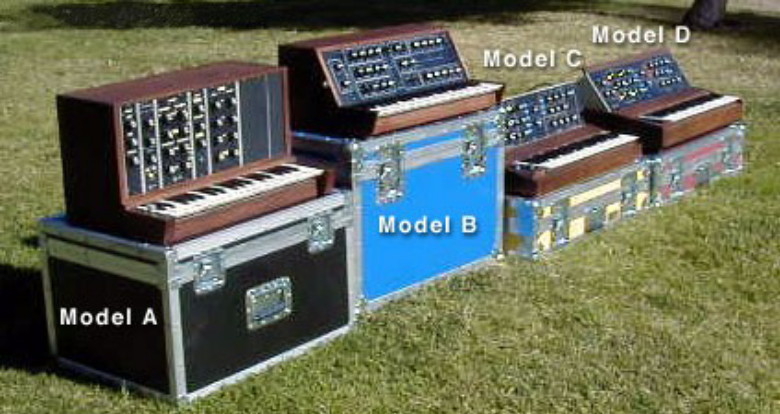
The Minimoog prototypes, up to the definitive model D
Modular synthesizers weren’t sold in instrument shops, only directly from the factory or through a handful of specialist dealers, and sales were scarce. Bob Moog eventually gave the project the green light, and after a few further tweaks, the final Minimoog D model was born, going on sale in 1970.
The Minimoog model D was revolutionary, and it’s the synthesizer that inspired a great many of the synthesizers that followed over the next few years — and, as we’ll see shortly, it remains one of the most highly regarded synthesizers even today. In terms of compact size, EMS had already released the remarkable VCS-3 back in 1969, which I’ll probably cover in another article, but that instrument was still modular in the sense that its various modules had to be patched together. The Minimoog D was the first compact, non-modular synthesizer, and it was far simpler to use (*1, though see the note at the end of the article).
It was also the first synthesizer sold on a large scale in musical instrument shops, and at a price of $1,500 it wasn’t cheap, but it was far more affordable than modular systems, which started at $4,000 and went up from there.
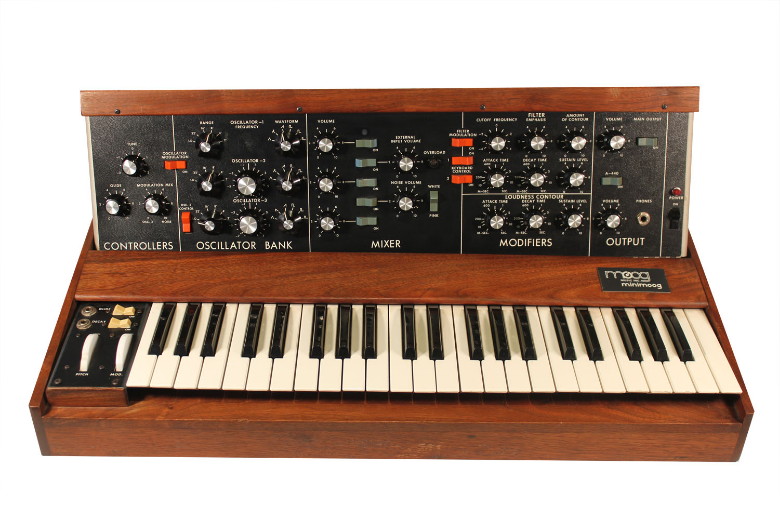
The Minimoog D
The model C’s sliding pitch-bend and modulation potentiometers were replaced with wheels, positioned to the left of the keyboard — an innovative idea that has remained a standard feature on a huge number of synthesizers to this day. Like the modulars, it was monophonic (with the exception of a few duophonic units — the first polyphonic synths wouldn’t appear until 1975), and the keyboard finally adopted had 44 keys. At the time, keyboards still had no touch or velocity sensitivity.
It offered spectacular lead sounds, entirely different from the organ tones everyone had grown used to up to that point, and it let keyboardists compete in solos with guitarists from a compact, straightforward instrument. Thanks to its compact size, it could be placed on top of other flat-topped keyboards, such as acoustic or electric pianos, organs, Mellotrons and so on.
That said, it still suffered from the usual problem of synthesizers from that era going out of tune, especially with changes in temperature, but also humidity or being transported around.
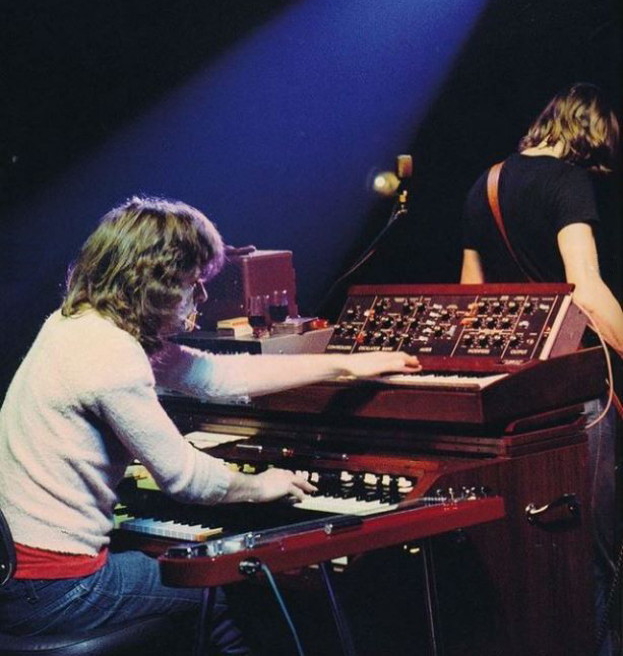
Rick Wright of Pink Floyd with the Minimoog placed on top of the Hammond RT-3
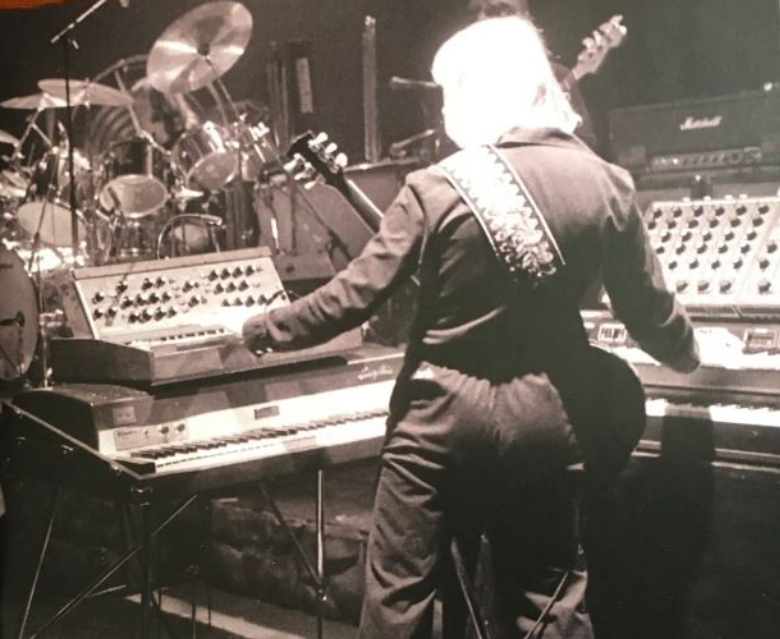
Kerry Livgren of Kansas with the Minimoog placed on top of the Fender Rhodes electric piano
A huge number of melodies and solos on classic Prog records were played on a Minimoog; probably its most illustrious user was Rick Wakeman of Yes. Wakeman didn’t like having to change the instrument’s sounds mid-concert (instruments still had no program memory back then), so if he wanted to use 4 different Minimoog sounds across a setlist, he’d simply bring 4 units, each already set up with its own sound. Even today, Wakeman says the Minimoog remains his favourite synthesizer.
The list of other Minimoog users would be endless — Keith Emerson of ELP, Rick Wright of Pink Floyd, Pete Bardens of Camel, Geddy Lee of Rush, Tangerine Dream, Klaus Schulze, Kansas, Supertramp… One notable exception is Tony Banks of Genesis, who stayed loyal to his ARP Pro-Soloist, and later the ARP 2600 and Quadra, and later still the Sequential Circuits Prophet synths.
Among famous classic Prog keyboardists, there are two cases who commissioned very special versions of the Minimoog. Keith Emerson, for one, had a split unit built, with the controls section and the keyboard section separated and connected by a cable. This let him fit the keyboard into a small space while the controls section sat somewhere more out of the way. He used it on the 1977 tour, with the keyboard positioned to the left of the Hammond C-3 organ.
The other was Patrick Moraz, who commissioned an exclusive double Minimoog.
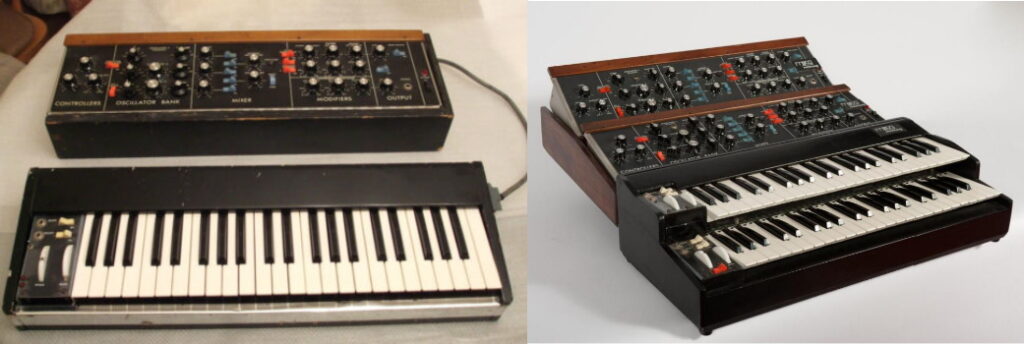
Keith Emerson’s split Minimoog and Patrick Moraz’s double Minimoog
The Minimoog was manufactured until 1981, when Moog was about to release the Memorymoog, which already had 6 voices of polyphony and program memory. But Moog failed to adapt to the coming digital era and went bankrupt in 1987. The rights to the Moog name became available and were acquired by two people: Don Martin acquired them for the USA, and Alex Winter for the UK (the latter including the rights to the “Minimoog” name), and both went on to build a few Minimoog units in the ’90s — Don Martin’s known as the “Donimoog”, and Alex Winter’s as the Minimoog 204E, or “the Welsh Minimoog” — both fairly rare today.
In the late ’90s, though, a nostalgia and market for original Minimoogs resurged, with units fetching very high prices second-hand. Bob Moog launched a legal battle to reclaim the rights to the brand and won it for the USA, and in 2002 he reopened Moog, launching the Minimoog Voyager — also analogue and monophonic, but heavily improved and featuring modern conveniences like a touch-sensitive keyboard, program memory and MIDI. In 2010 the XL version came out, with a 61-key keyboard instead of 44. Bob Moog, however, never recovered the rights for the UK, where the new instrument had to be sold as the “Voyager by Bob Moog”.
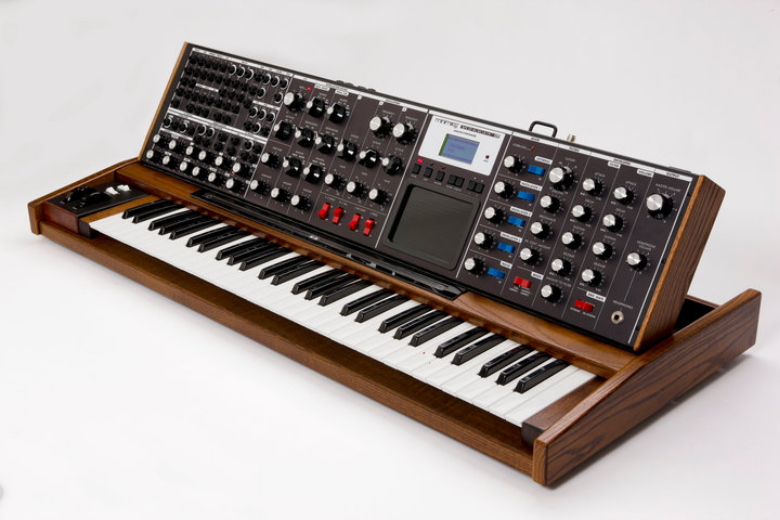
The Minimoog Voyager XL
In 2016 they released a reissue of the original model D, very faithful to the classic instrument with just a couple of improvements, like a touch-sensitive keyboard and very basic MIDI, and in 2022 it received a few more upgrades still. That said, it’s a very expensive instrument, nearly $6,000 — you could call it an indulgence for the nostalgic.
So the Minimoog, 54 years after its launch, remains a relevant, current instrument — which confirms it’s an icon in a way very few other instruments can claim.
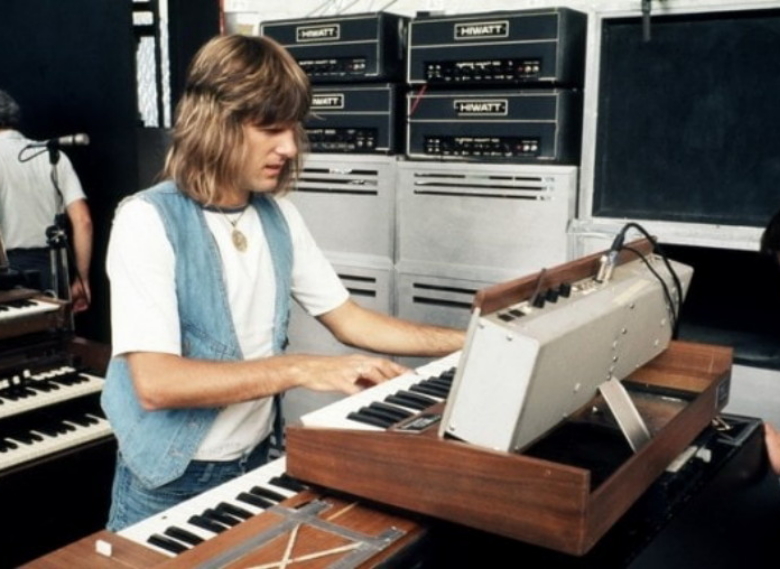
Keith Emerson with a Minimoog placed on top of the Hohner Clavinet D6 (which in turn usually sat on top of the Hammond L-100 organ, or sometimes the acoustic piano)
(*1) Earlier I said the Minimoog was the first compact, non-modular synthesizer, and that’s generally how it’s credited, but the real story is a little more complicated than that. In fact, it was Gene Zumchak, one of the first engineers hired by Moog, who came up with the idea of a compact, easy-to-use synthesizer around 1968, but Bob Moog wasn’t interested, and on top of that the two of them didn’t really get along. An entrepreneur named Bill Waytena sensed that an instrument like this could be successful, and in 1969 he hired Zumchak, who designed the Sonic V synthesizer, while Waytena set up the company muSonics to sell it — but it never found a commercial market.
At Moog, as I explained at the start of the article, Bill Hemsath picked up Zumchak’s idea and developed what would become the Minimoog.
Despite launching the Minimoog in 1970, R.A. Moog was in serious financial trouble, and Waytena agreed to buy the company, keeping Bob Moog on as President, merging it with his own, and renaming it Moog/muSonics (in 1972 it became Moog Music). Moog/muSonics did release the Sonic V as a production model in 1971, but Bob Moog naturally favoured his own Minimoog, so the Sonic V never got much support and very few units were made. The Sonic V’s basic design was, however, reworked into the Moog Sonic Six model, launched in 1972, aimed mainly at academic and educational use. It’s because of this origin in Zumchak’s design that the Sonic Six didn’t resemble any other Moog product of the era.
So the Sonic V was designed practically at the same time as the Minimoog, the two running in parallel, but it was the Minimoog that became the first one to be successfully brought to market.
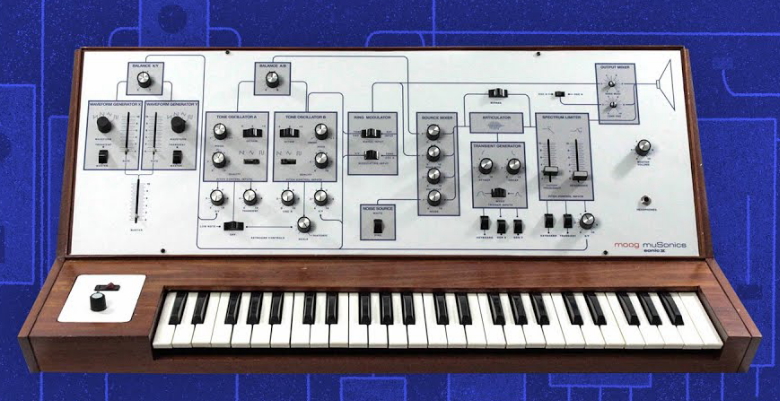
The Moog/muSonics Sonic V
Until next time!
Gerard Bassols
If you enjoy this topic, remember you’ll find much more information in the book “Los Instrumentos Musicales del Rock Progresivo; Guía Ilustrada”, available at this link. Have you read the readers’ reviews yet?
https://www.amazon.es/instrumentos-musicales-Rock-Progresivo-ilustrada/dp/8413318645
And if you’d prefer, it’s also published in English:
https://www.amazon.com/Musical-Instruments-Progressive-Rock/dp/8413385997