
Today I’ll talk about guitars, starting with probably the most famous and successful one in the history of Rock: the Fender Stratocaster. Obviously, throughout the history of Rock music there have been many significant electric guitar models from various manufacturers, and in future articles I hope to talk about some of them. But if we focus on the world of successful ’70s Rock, there were two major camps that dominated: guitarists who preferred the Fender Stratocaster, and those who preferred the Gibson Les Paul.
Rock guitarists were often firmly committed to one or the other, but the truth is that among Progressive Rock guitarists this divide was much less clear-cut, and it was more common for them to play guitars from different manufacturers and models, since generally speaking they were more interested in pursuing tonal diversity than in establishing a very defined, homogeneous personal sound and image, as was often sought in other Rock genres.
Some who have clearly favoured the Stratocaster as their guitar of choice include, for example, Jimi Hendrix, Ritchie Blackmore, David Gilmour, Jeff Beck or Trevor Rabin, though many others have also used it with varying degrees of frequency.

Mike Oldfield playing a Stratocaster in 1999
The Stratocaster, often shortened to the “Strat”, was launched in 1954 and was Fender’s second solid-body guitar model designed for mass production, following the Esquire/Telecaster of 1950. The Stratocaster was truly revolutionary in many respects. Beyond the fact that solid-body guitars were still a very new thing in themselves, its rounded-contour body was also a novelty — guitars up to that point had straight-edged bodies. It had two horns (a double-cutaway design, which Fender had debuted on the Precision bass in 1951), and the upper horn allowed the strap to be attached roughly over the 12th fret, giving good weight balance while still allowing the hand access to the highest part of the neck. These two features made it especially comfortable to play standing up.
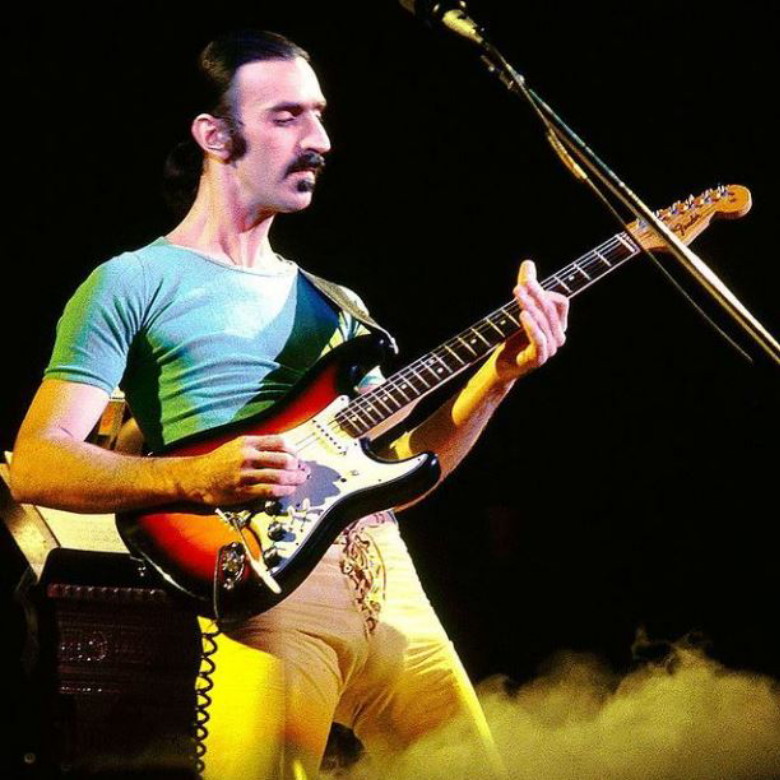
Frank Zappa playing a Stratocaster in a sunburst finish (that flame-blended tone on the body)

Steve Howe playing a Strat in 2012 — note that it’s been modified with just 2 potentiometers (master tone and master volume) instead of the standard 3.
The headstock design, with all 6 string tuning pegs lined up along the top, was also fairly new, though it had already been used on the handcrafted 1948 Bigsby Merle Travis and on Fender’s own Esquire/Telecaster.
Another novelty was the use of 3 pickups, in this case single-coil pickups, offering a wide variety of possible tones. These were managed with a 3-position linear pickup selector, which in 1977 became a 5-position switch, further increasing tonal versatility. It also had 3 potentiometer controls — the standard configuration being two tone controls assigned to the neck and middle pickups (the bridge pickup has no tone control) and one master volume. Another distinctive feature was the angled jack output on the front. All the electronics were easily accessible by removing its large front-mounted pickguard, unlike other guitars where access is through one or more rear covers.
The neck originally had 21 frets, though most modern Strats made from the mid-’80s onward have 22, and the scale length (the length of the strings from bridge to nut) was 25.5 inches, a little longer than the 24.75 inches of its great rival, the Gibson Les Paul.
The other great novelty was its so-called synchronised “tremolo” bridge, where working the bar reduces string tension, lowering the pitch of the note (or, to a limited extent, raising it by increasing tension). Bigsby had already brought out a “tremolo” bar bridge, but Fender’s design was better and allowed for a wider range of pitch variation. I’ve put “tremolo” in quotation marks because, while it’s the popular name, it’s technically incorrect. Tremolo is a variation in amplitude (volume), while the correct term for the pitch variation the bar produces is “vibrato”, so it really ought to be called a “vibrato bar”. The error seems to originate with Fender itself, which used the incorrect term “tremolo” when filing its patent application for the system, and advertised it under that name too, which stuck and has endured to this day. So from here on, I’ll also use the popular terminology and call it a “tremolo bar” bridge.
The Strat was also offered with a simpler fixed bridge, but these versions were far less successful.

An advert for the Stratocaster showing off its innovative “synchronised tremolo” bridge.
All told, it was a highly revolutionary concept and design for its time — in fact, people initially found it too extravagant, and sales weren’t particularly good until the late ’50s/early ’60s. From then on, though, the Strat has remained extraordinarily successful, with very few changes, right up to today.
Following its general design, many versions have been made with their own particular specifications, from the types of wood used to the neck profile, the specific pickup model, the bridge, the tuning pegs and every other detail, resulting in everything from fairly affordable versions to the most sophisticated and expensive ones. They’ve also been manufactured in various countries where Fender has had factories, which, besides affecting the price, also means expert or purist guitarists often prefer instruments from a particular country of origin over others.
Fender has had several owners throughout its history, and the period considered the lowest in quality is 1965 to 1988, when it was owned by CBS. After that, quality had its ups and downs, improving considerably from 2012 onward, but even today the most highly valued Strats are those from the pre-CBS era, up to 1964.
One especially visible specification is the type of wood used for the fingerboard. In fact, in the early years, Stratocasters had a one-piece maple (light-coloured wood) neck with no separate fingerboard. From 1959 onward, a separate fingerboard glued to the neck was adopted, and the fingerboard is usually either maple as well, or rosewood (dark wood).

David Gilmour with his “Black Strat”, one of his favourite guitars, which he modified over the years. On the left we see it with a rosewood-fingerboard neck, and on the right with a maple one. At different times he’s also had it fitted with a white or a black pickguard.
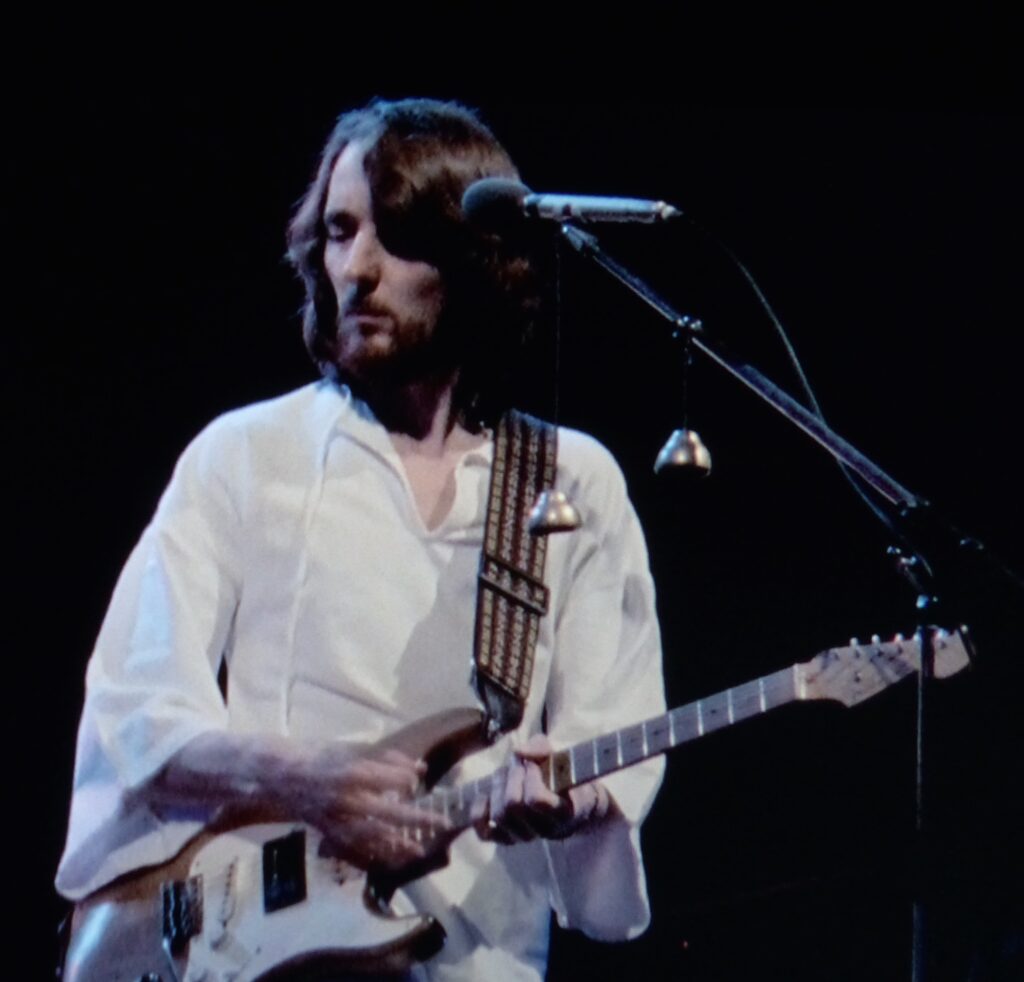
Roger Hodgson of Supertramp — note his Strat was modified with a humbucker pickup in the middle position, a “Fat Strat” SHS configuration.
Guitarists often customise their guitars with their own personal touches, and quite a few renowned guitarists have had their own signature version built to their own preferred specifications, replicas of which are often sold commercially.
Single-coil pickups, like those used on the Strat, produce a clean sound with a lot of subtle tonal nuance, but they tended to hum when the volume was pushed up a lot, or once distortion started being used as a sound effect. In 1955 Gibson began popularising the use of double-coil pickups on guitars (known as humbuckers), which largely mitigated this problem, and it turned out they also produced a more powerful sound — maybe less subtle, but with more body and punch. Various guitarists have fitted humbuckers to their Strats to get these more powerful tones, especially in the bridge position, though sometimes also in the middle or neck. These guitars are popularly known as “Fat Strats”.
Pickup type is usually abbreviated as S for Single Coil, or H for Humbucker, and a guitar’s pickup configuration is written using these letters in bridge–middle–neck order; for example, SSS is the standard configuration with 3 single coils, while HSS, SHS or HSH are Fat Strat configurations.
From the late ’70s/early ’80s onward, a new generation of guitarists emerged, led by Eddie Van Halen, who developed new playing techniques, mainly for lead playing and geared towards Metal styles, based on high speed, precision, right-hand techniques like sweep picking, tapping — producing sound by pressing the fingertip onto the fretboard with either hand, without needing to pick or pluck the string with the right hand — and the use of effects such as extreme bending and heavy use of the tremolo bar.
This playing style is known as shredding, and the guitarists who practise it as shredders. Some shredders who have kept a more or less progressive approach in their music include Steve Vai, Shawn Lane, Greg Howe, John Petrucci or Guthrie Govan.
To be able to fully exploit these techniques, Eddie Van Halen built his own famous guitar, known as the Frankenstrat, which had a Stratocaster body (actually a replica made by Charvel), a Stratocaster-style neck also modified by Eddie himself, a Gibson PAF humbucker pickup, and a Fender tremolo bridge, which he soon swapped for a more reliable Floyd Rose.
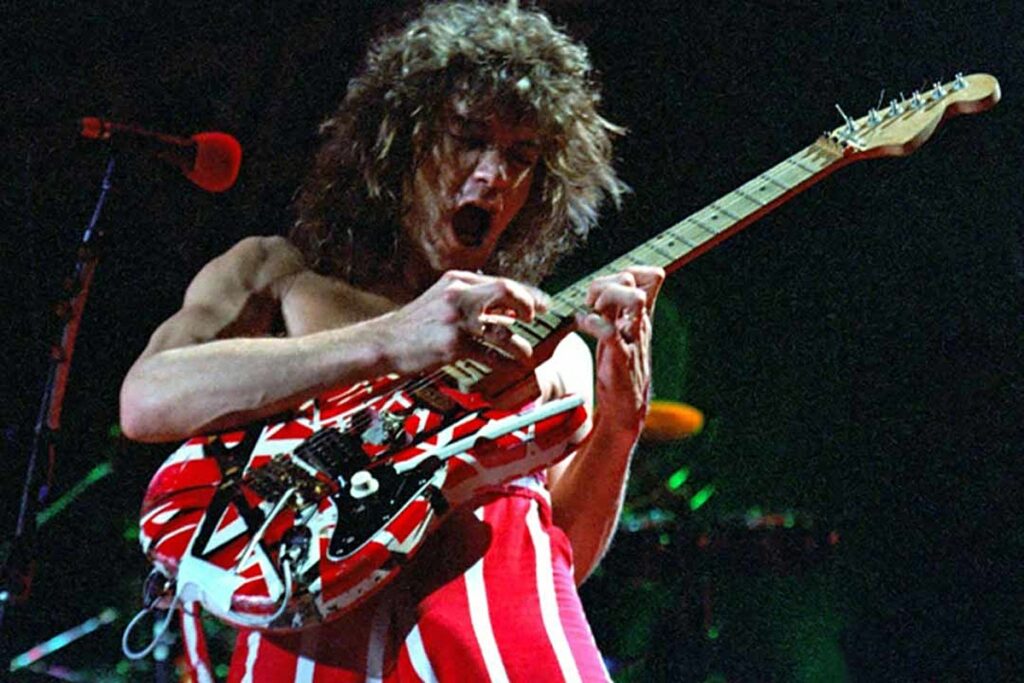
Eddie Van Halen playing his Frankenstrat.
This led to the emergence of a new class of guitars inspired by the Fender Stratocaster, but with features especially suited to these techniques: a flatter, faster neck geared towards playing solos rather than chords, often with 24 frets and built as a single piece with the guitar body for easier access to the higher frets (a design known as neck-through construction), a tremolo system that could withstand heavy use without going out of tune, and high-output humbucker pickups, at least in the bridge position. These guitars are generically known as “Superstrats” — there have been quite a few models from various manufacturers, and they became hugely successful from the mid-to-late ’80s onward in Metal music, including Prog Metal, which gained real momentum in the ’90s; I may dedicate a future article to them in more detail.

Mike Holmes of IQ with his customised Strat fitted with two humbucker pickups, at the bridge and neck — an HSH Fat Strat.
Until next time!
Gerard Bassols
If you enjoy this topic, remember you’ll find much more information in the book “Los Instrumentos Musicales del Rock Progresivo; Guía Ilustrada”, available at this link. Have you read the readers’ reviews yet?
https://www.amazon.es/instrumentos-musicales-Rock-Progresivo-ilustrada/dp/8413318645
And if you’d prefer, it’s also published in English:
https://www.amazon.com/Musical-Instruments-Progressive-Rock/dp/8413385997