
Today’s article is dedicated to what is probably the most iconic and widely used keyboard instrument of the 20th century: the Hammond organ.
It was invented by Laurens Hammond in the USA in 1934 as a more affordable alternative to pipe organs in churches and pianos in upper-middle-class homes. Since then it’s been hugely present in popular music of every kind and every era, from modern interpretations of classical organ music, contemporary religious music, Gospel, Jazz, Blues, Soul, Pop, Classic Rock, Hard Rock, and of course Progressive Rock, where it was, and still is, a very prominent instrument.

A Hammond B-3 with a Leslie speaker/amplifier beside it
The Hammond is an electro-mechanical organ, but in many ways its operating principles are equivalent to those of an additive-synthesis synthesizer.
I don’t want to get too technical here — for anyone interested, I explain the Hammond’s workings in full detail in the book, with illustrations and examples. But basically, an additive-synthesis synthesizer works by generating several sine waves, layering them together, and adjusting the amplitude of each one to produce a final wave that already has its own timbre, its own sound. By adjusting the amplitudes of the different waves, you can create multiple timbres, multiple different sounds. This is different from the method used by the vast majority of ’60s and ’70s synthesizers, which used subtractive synthesis — the opposite approach, starting from a complex wave and filtering out frequencies to arrive at the desired timbre.

Tony Banks of Genesis’s rig in 1974, with his Hammond T-102
The Hammond therefore has two main components. First, sound-wave generators called tonewheels — toothed steel wheels that spin in front of an electromagnetic pickup and generate a sound wave for a given note. Every time you press a key, it activates 9 tonewheels, which generate the main note for the key played plus 8 further notes called harmonics.
The other main component is the drawbars, which let you adjust the amplitude of each of these notes, and it’s this adjustment that produces the different timbres the instrument can generate. Each manual has its own set of 9 drawbars, and each drawbar has 8 possible settings, which gives an enormous number of possible sounds. This huge versatility has undoubtedly contributed to the Hammond’s success across such a wide variety of music — it can produce anything from baroque organ tones to fierce, aggressive sounds for the heaviest Hard Rock.
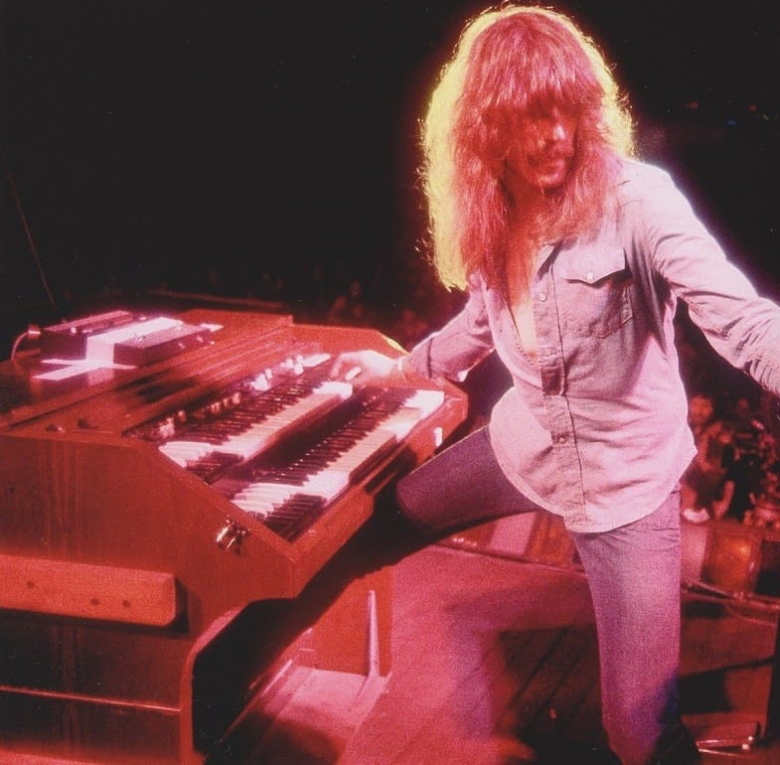
Jon Lord playing his C-3
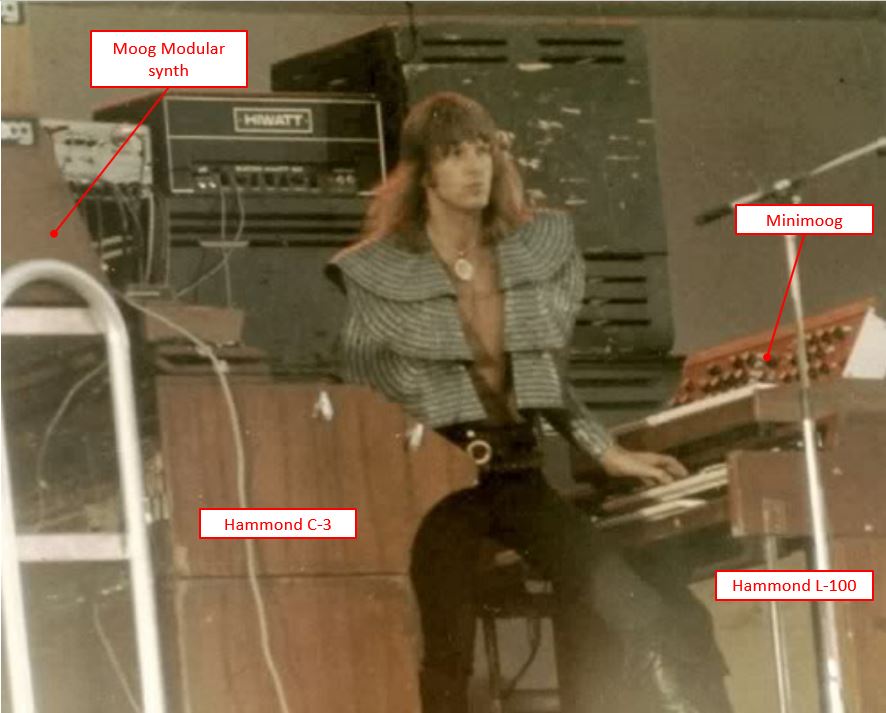
Keith Emerson in 1972 with his rig, which included the Hammond C-3 and L-100
There have been many models of the Hammond organ, but in the context of classic ’70s Prog, the most widely used can be grouped into two families: the so-called console models, like the B-3, C-3, A-100 or RT-3 (usually with 2 manuals of 61 keys), and the so-called spinet models, smaller and simpler (usually with 2 manuals of 44 keys), like the L-100, M-100 or T-102.
The B-3 and the C-3, probably the most famous and most widely used, were practically identical technically, but differed in their cabinets — the B-3 had an open base with 4 legs, while the C-3’s was enclosed at the front and sides.
Keith Emerson mainly used a C-3 (positioned beneath the Moog modular synthesizer) for most of his playing, but live he also had an L-100, which, besides playing extra parts on it, he used for his famous stage antics — climbing on top of it, stabbing knives between the keys to hold notes sustained, playing it upside down from the floor, and so on.
Rick Wakeman of Yes also mainly used the C-3, though he used the B-3 as well.
Tony Banks of Genesis used the spinet models, first an L-122 until 1974, when he switched to a T-102. Banks used the T-102 for quite a few years, up until the “Duke” album tour in 1981, after which he replaced it with the Sequential Circuits Prophet-10 synthesizer.
Pink Floyd’s Rick Wright used several models — in the early years, an M-102 spinet up until 1972. For 1973’s “The Dark Side of the Moon” he switched to a console RT-3, and later on he also used B-3s and C-3s.
Thijs Van Leer of Focus and Steve Walsh of Kansas also played a C-3, Hugh Banton of Van Der Graaf Generator played an E-112, and Rick Davies and Roger Hodgson of Supertramp mainly played B-3s and an M-162.
In the world of ’70s Symphonic and Progressive Rock, practically every respectable keyboardist had a Hammond in their rig. Moving a bit more towards Hard Rock, another illustrious Hammond player was Jon Lord of Deep Purple (and later Whitesnake), who also typically used a C-3, and Don Airey of Rainbow and later Deep Purple used an A-100. And leaning more towards Rock and Jazz-Rock, we have Brian Auger and Billy Ritchie, who were also major reference points for the Hammond.
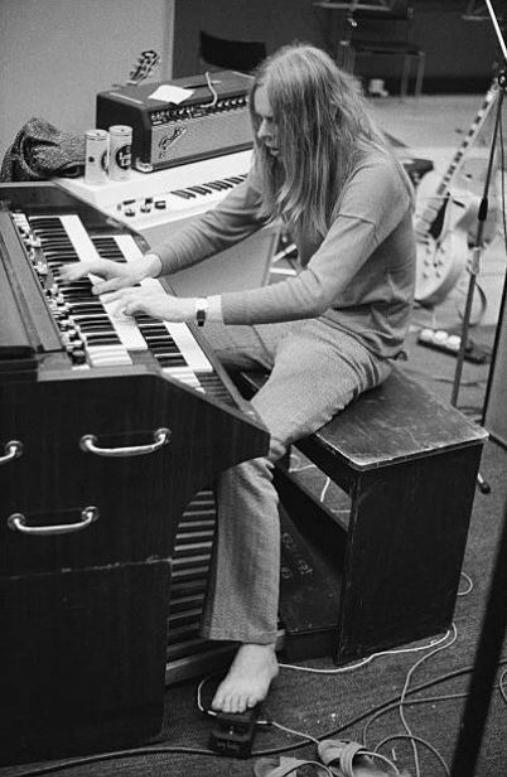
Rick Wakeman playing a C-3 in 1971. To his right you can see the Mellotron M400
Hammonds were often paired with Leslie speaker-amplifiers, which gave them a very particular sound — a kind of blend of vibrato, tremolo and phaser effects all mixed together. This is achieved because the speakers rotate in the horizontal plane, producing an alternating Doppler effect in the sound waves coming out of the cabinet.
Leslies were mainly used with organs and keyboards, but several guitarists also used them, such as David Gilmour of Pink Floyd or Jan Akkerman of Focus, and even some bassists. Back when bands still had to play without PA systems (central mixing desks and amplification, meaning each musician carried their own individual amp/speaker), the Hammond + Leslie combination was the first organ setup with enough volume to let keyboardists play alongside electric guitarists without inevitably sounding like a background instrument, and they were able to compete with guitarists, delivering their own powerful solos too.
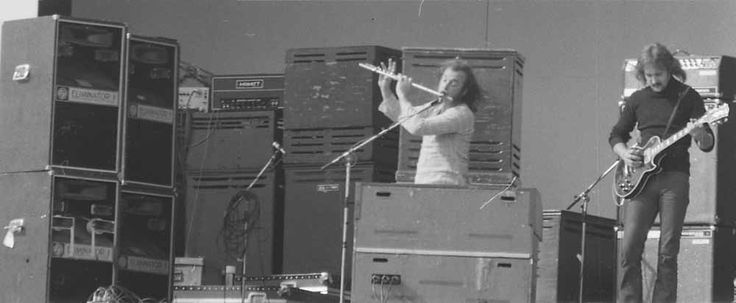
Focus in concert in 1972. The cabinets with horizontal slats behind Thijs Van Leer are Leslies. In front of him is his Hammond C-3, while Jan Akkerman plays his Gibson Les Paul guitar
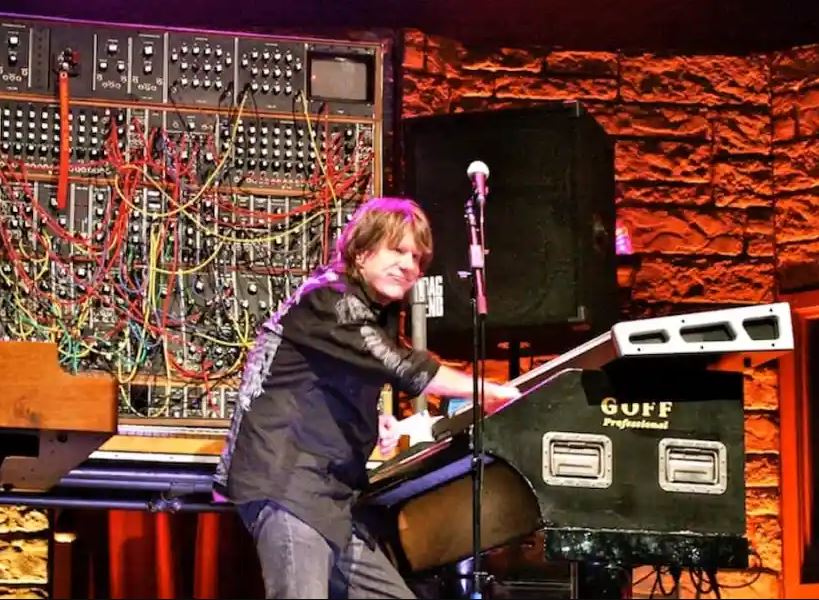
Keith Emerson playing his custom Goff Hammond C-3 in 2010. On top of it sits a Korg Oasys synthesizer, and behind him, the famous Moog modular
In the ’70s, transistor-based electronic technology was becoming dominant, and it seemed an electro-mechanical instrument like the Hammond would end up obsolete; Hammond began manufacturing electronic transistor models like the B-3000 console model or the K-100 spinet, and by around 1975 they had stopped making tonewheel models altogether. But while these new electronic models still found a certain market in niches like private buyers or funeral homes, they failed to win over professional musicians, and on top of that, modern popular music was leaning heavily towards the new generation of electronic synthesizers, leaving organ sounds looking rather old-fashioned.
Despite the enormous success Hammond had enjoyed, the company went bankrupt and closed in 1985 (likely also influenced by the fact that founder Laurens Hammond died in 1973, and his successors failed to steer the company properly through the times).
After a period rescued by Australian owners, in 1989 the company was bought by Japan’s Suzuki Musical Instrument Corporation (which also bought Leslie), and it continues to manufacture and sell Hammond instruments to this day.
In the ’90s Keith Emerson asked Al Goff to modify his C-3. Goff is a highly renowned Hammond dealer (based in Connecticut, USA) who has spent decades maintaining, repairing and modifying Hammonds and Leslies. Goff removed the lower section to make it more portable, added extra controls to manage effects such as reverb, chorus and percussion, and painted it black.
Today there are digital Hammond models, such as the XK-5. This can be paired with the optional XLK-5 lower keyboard and the XPK 250 pedal module for a full replica of a classic B-3, but entirely digital and with all the modern conveniences.
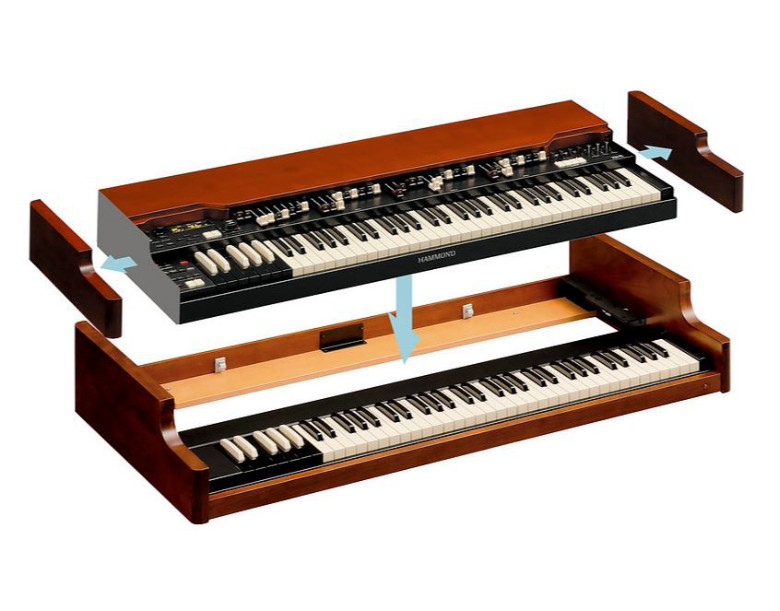
The Hammond XK-5 with the optional XLK-5 lower manual
Digital Hammond emulators from other manufacturers also appeared, such as the Roland VK-8, the Nord C, or the Korg CX-3. Modern Hammond emulators usually also include Leslie effects, digitally generated. While it’s no longer common to see musicians using a vintage tonewheel Hammond, Hammond sounds in digital form remain widely used in Prog, especially in so-called Retro-Prog, but also in more innovative sub-genres.
Hammond’s current top-of-the-range model is the SKX PRO, with dual manuals, which also offers plenty of sounds beyond just organ tones.
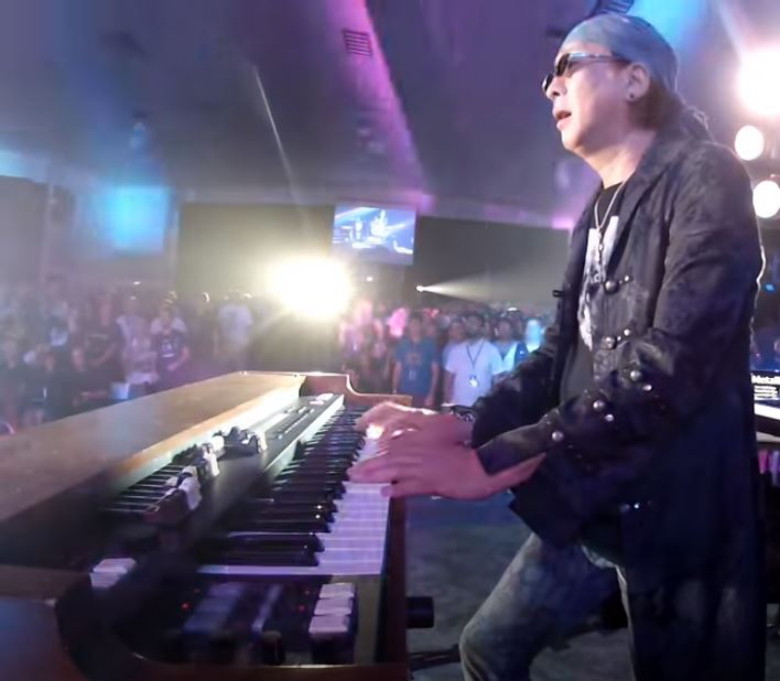
Ryo Okumoto of Spock’s Beard playing a Korg CX-3, a Hammond emulator
Until next time!
Gerard Bassols
If you enjoy this topic, remember you’ll find much more information in the book “Los Instrumentos Musicales del Rock Progresivo; Guía Ilustrada”, available at this link. And if you need to start thinking about Christmas or Epiphany presents, now you know!
https://www.amazon.es/instrumentos-musicales-Rock-Progresivo-ilustrada/dp/8413318645
And if you’d prefer, it’s also published in English:
https://www.amazon.com/Musical-Instruments-Progressive-Rock/dp/8413385997