
Progressive Rock
bacillus records · 6 February 2026
The opening suite runs fifteen minutes forty-eight and carries six titles inside it (“Fermillon”, “Puppet Dance”, “Square”, “Hope?”, “Morning Spirit” and “Fermillon Himself”). It begins with a saturated guitar chord and, before a minute is out, there is already flute and piano underneath; around the four- or five-minute mark the groove dissolves and what is left is an electronic bath of pulsing bass tones that comes from no genre at all but from the mixing desk. That is the record: a band that writes and rehearses meticulously and then uses the studio to break what it has just written.
Nine Days’ Wonder were from Mannheim and came out of Walter Seyffer’s earlier group, The Graves, who played English and American hits. The 1970 line-up added up to four nationalities: Seyffer on vocals, Rolf Henning on guitar and piano, Austrian Karl Mutschlechner on bass, Irishman John Earle on vocals, saxophone, flute and guitar, and Englishman Martin Roscoe on drums. Peter Hauke signed them to bacillus records, his new label, and the album was recorded in 1971 in Cologne-Stommeln with Dieter Dierks at the desk. Dierks’s name is worth remembering, because a good deal of what sounds strange here is his.
What separates this record from its contemporaries is that it does not improvise. While Can and Faust worked with cyclical drift, here there is architecture: guitar and saxophone in unison, metre changes placed deliberately, and a way of moving from heavy rock to jazz-rock that sounds negotiated rather than stumbled upon. “Apple Tree” concentrates it into six minutes forty-five — an acceleration into an instrumental of unstable metre, with Henning and Earle handing the line back and forth — and it is the track that best defends the album against anyone inclined to write it off as an eccentricity. “Moss Had Come”, three twenty-seven, takes the short route: assault, an acoustic truce in the second minute and a final eruption, without a bar to spare.
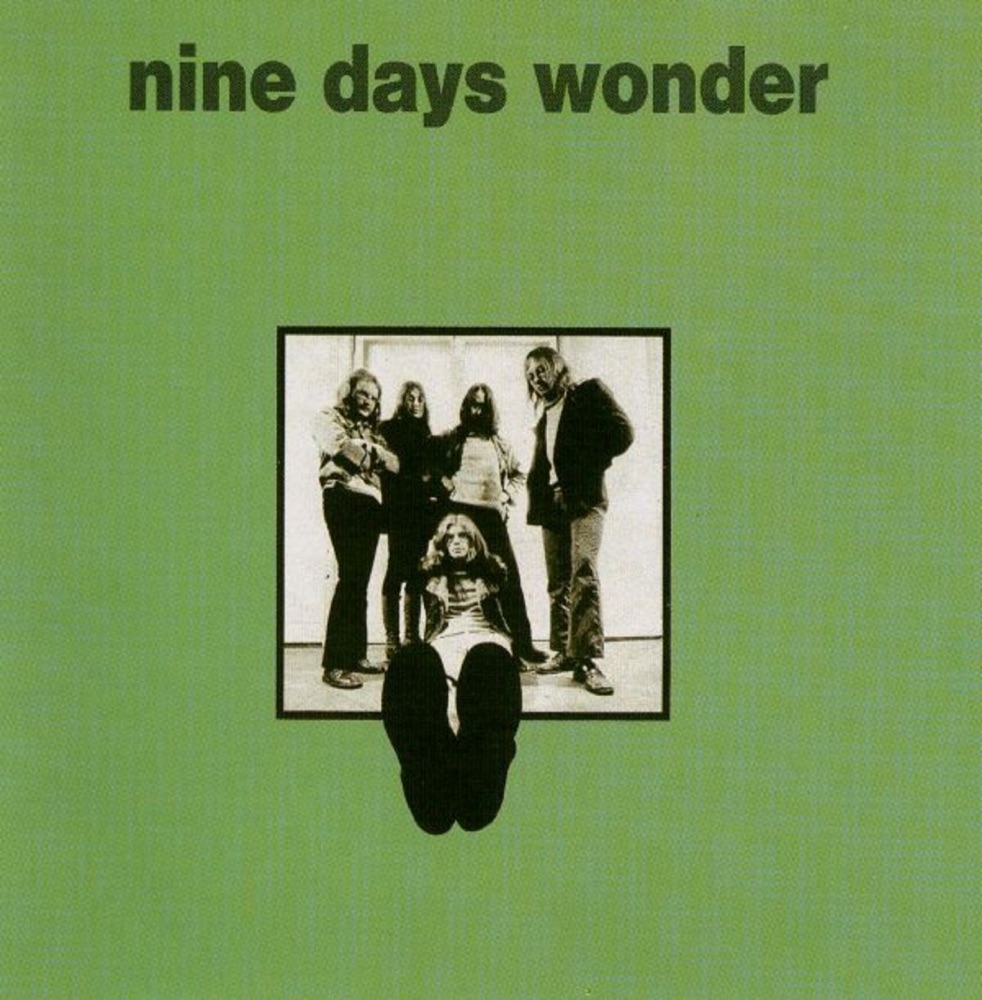
The bacillus archive release keeps the four original pieces and the classic artwork, and here is the detail that explains the record’s reputation. The first German pressing came in a green foam-rubber gatefold designed by Seyffer himself; the British Harvest edition swapped the foam for Hipgnosis’s dead fish. Sounds praised its originality and instrumental balance at the time, and Musikexpress its nervy pace. The band toured Germany, Austria and Switzerland between 1970 and 1972.
The reservation belongs to 2026 rather than 1971: this reissue carries no alternate take, no facsimile of the period press, no claim of remastering. It is the same thirty-eight minutes forty-eight as always, in digital, with a page of text beside it. And there is an internal limit worth stating: Seyffer’s vocal register, which swings from low menace to operatic absurdity several times per piece, is the device that makes the first listen memorable and the one that weighs most by the fourth, above all on the closing suite, where the tension is held open for thirteen minutes and never resolves. That it does not resolve was the idea; that the gesture repeats this often, probably not.
Rating: 7.9/10
Text by Guillem Cardós