
Jazz
RogueArt · 22 May 2026
A two-piano record usually says who is playing in which channel, because it is the first thing a listener wants to know. “Katarahi” does not, and not by oversight: Myra Melford and Satoko Fujii swapped instruments during the concert that produced it. Fifty-one minutes and thirty-three seconds in which the listener can now and then guess at a gesture from one or the other and has no way of confirming it.
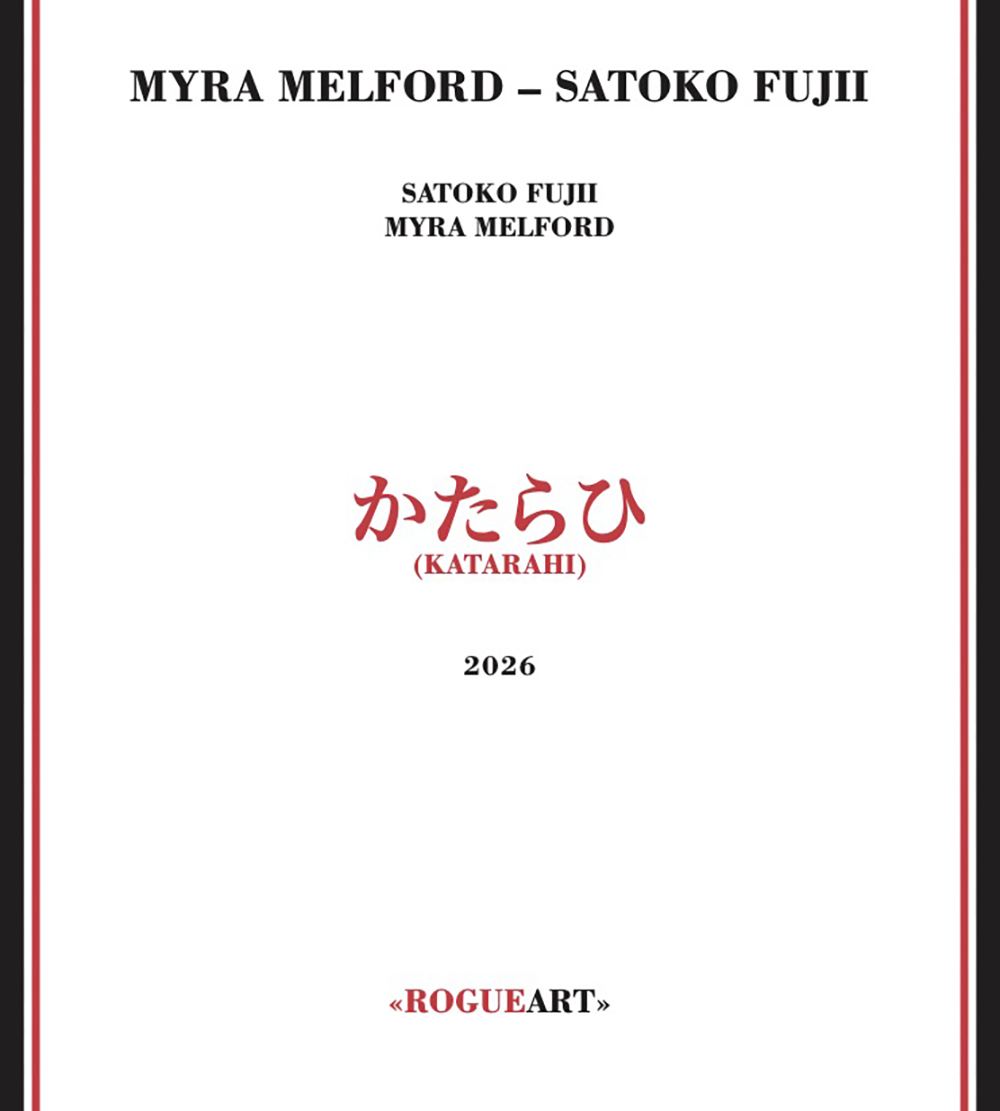
The concert is from 27 September 2024 at the Jazzfestival Leibnitz, in Austria, and was recorded by ORF with Norbert Stadlhofer at the desk. RogueArt released it on 22 May 2026, with liner notes by Ed Hazell. It is the two pianists’ second duo record and it comes very late: the first, “Under The Water”, was recorded on 14 September 2007 at Maybeck Studio in Berkeley and did not come out until 2009, on Libra, which puts almost exactly seventeen years between the two sessions. The title was Fujii’s suggestion: in Japanese, “katarahi” is the heart-to-heart conversation between close friends. “I chose it because when I play with Myra, I always feel like I am having a conversation with my close friend”, the pianist explains in the album notes.
Of the seven tracks, Melford signs four (1, 3, 4 and 6) and Fujii the other three. “Interlude I” opens with ripples that cross each other and a lyricism the record will not grant again; “Signpost” passes a single phrase from one to the other, first as call and response and then overlapped like a fugue, with excursions down into the bottom end. “Pairs” begins with one of them under the lid, playing the strings directly to draw a buzz out of them, while the other drops in dry, glancing notes. “Kaiwa”, ten minutes and thirty-five seconds, starts from an exchange of damped notes and Morse code, and “From Sometime” closes with ten unleashed minutes that end up revealing there was an audience: the applause had not been heard anywhere else on the record.
Two things here cannot both be had. Hiding who plays what puts the collective sound first, which is what the two of them wanted, but a two-piano record is precisely the format in which you can document how each pair of hands thinks, and that is given up from the start: in the end, fifty-one minutes of four-handed improvisation leave you knowing how the pair sounds and not how either of them gets there. And a note on form: a record that opens with a track called “Interlude I” and has no other interlude begins at a point its own title admits is not the beginning.
Rating: 8.0/10
Text by Aina Torrents