
Jazz
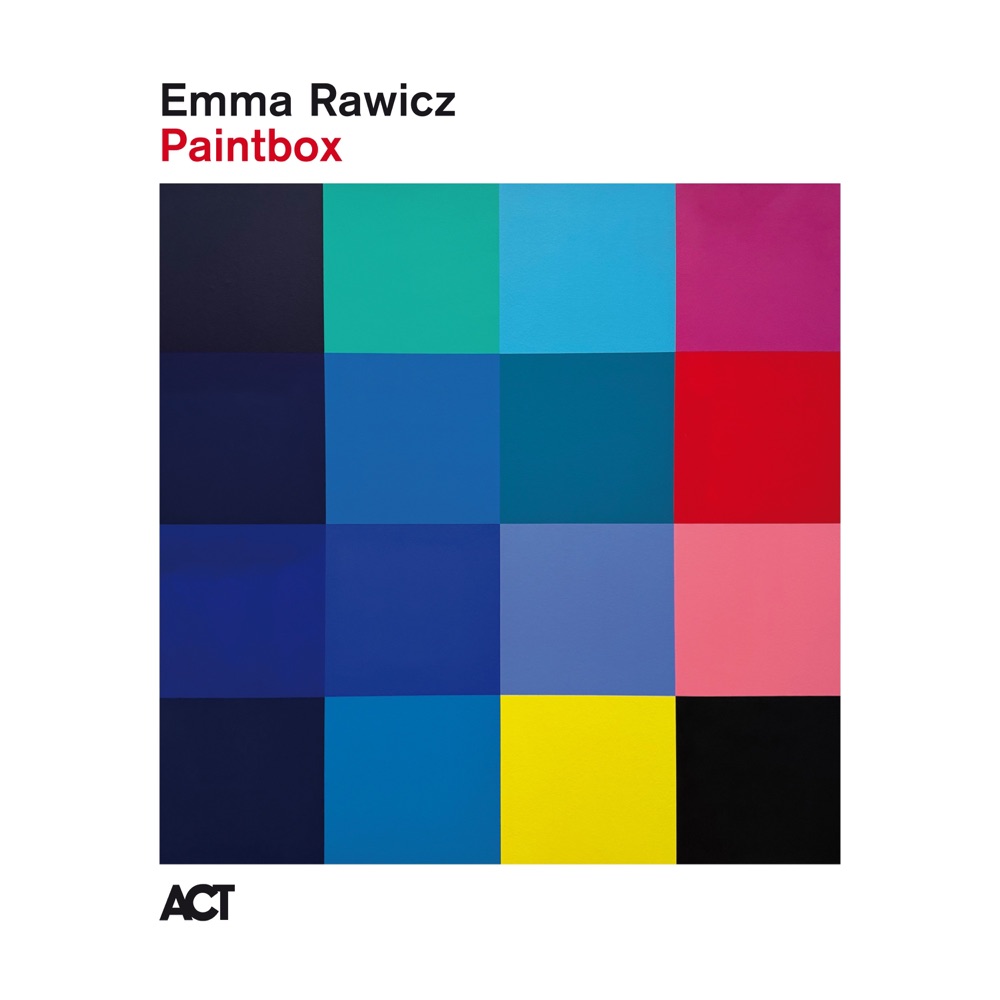
ACT Music · 28 August 2026
“Paintbox” runs forty-nine minutes and fifty-seven seconds on vinyl and CD, and twenty-nine minutes and thirty seconds on the platforms. The three tracks missing from streaming carry their own weight. There is “A Wide, Wide Sea”, which at nine minutes and forty seconds is the longest piece on the record; there is “Honeydew Ginger”, the first harmonically dense ballad Emma Rawicz has released, and there is the track that closes the album. Which means that anyone listening on Spotify hears neither the most ambitious piece of the set nor the ending its author wrote for it. The decision belongs to the saxophonist and to ACT, and it shapes the whole record.
It is Rawicz’s fifth album as a leader and her fourth for ACT: before it came “Incantation” (2022), self-released, and “Chroma” (2023), “Big Visit” (2025) and “Inkyra” (31 October 2025) for the German label. “Paintbox” arrives ten months after that last one, on 28 August, preceded by the single “Cowboys & Aliens” on the 14th. The quartet is Rawicz on saxophone, Elliot Galvin on piano, Kevin Glasgow on six-string bass and Asaf Sirkis on drums.
“Cowboys & Aliens” opens with a repeated riff closer to Steve Reich than to anything in the jazz repertoire, and that figure returns at the end of the track with more force than at the start; in between, the band stops dead and leaves Galvin’s piano on its own with a few taps from Sirkis. “Waldeinsamkeit” (the German word for the calm solitude of a forest) begins with the saxophone held back and the percussion barely hinted at, and ends as quietly as it began, like a sentence left halfway. “Quirky” is the opposite: eight minutes and thirty-seven seconds of insistent rhythmic pulse that recall the Nik Bärtsch of the clockwork pieces, except that nothing here is mechanical. And “Walking on Grass”, one minute and fifty-one seconds, begins with a frank burst of laughter and goes on being the strangest thing on the record. Glasgow’s bass, which in range reaches almost where a guitar would, does the work of colour rather than of foundation.
That same decision, seen from the other side, is what cannot be defended. A record split into two versions ends up with two endings, and that is not the same as having a special edition: anyone listening on streaming will come away thinking it is a twenty-nine-minute work that stops abruptly. That the cause is a good one — and pulling musicians out of their dependence on the platforms is one — does not make the short record complete. There is a second, smaller thing: the rate of invention is so high that an idea another player would have stretched into a whole track is spent here in eight bars and never returns. It shows most on the digital edition, which is where there are no spare minutes to breathe.
Rating: 8.3/10
Text by Aina Torrents