
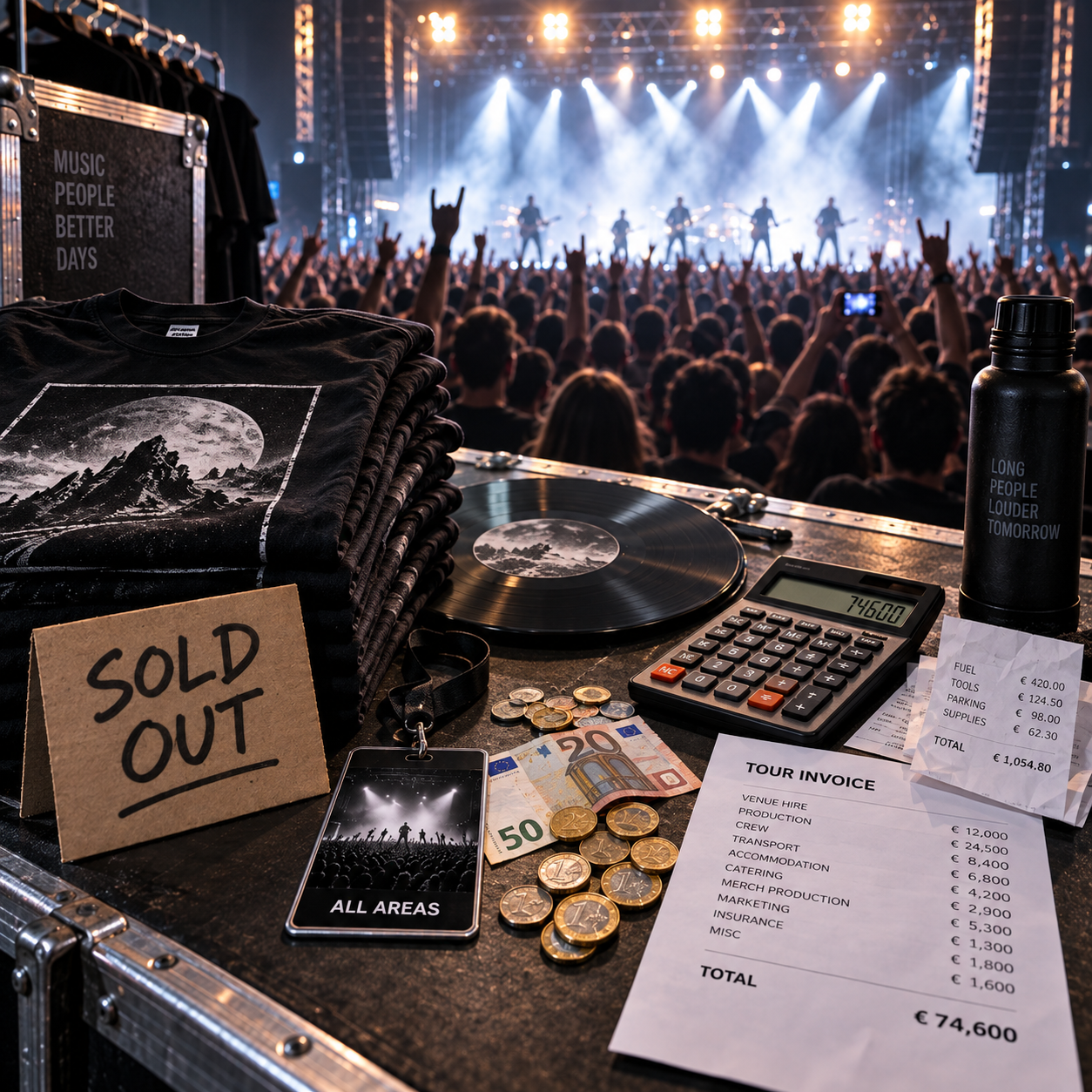
Sold-out tickets, a packed room, and hundreds of people singing along. From the outside, it looks like the band has had a great night. Maybe they have. What’s far less certain is whether they’ve actually made any money. Welcome to the real economics of touring in 2026.
There’s a scene that plays out almost every night in every concert venue. The lights go down, the final encore ends, and the musicians disappear amid applause. A while later, part of the crowd stops by the merch table, buys a t-shirt, a vinyl or a poster, chats about the show, and heads home.
Full room. Happy crowd. Show over.
The feeling is unmistakable: tonight went well.
But it’s entirely possible that, as the audience files out of the venue, someone is doing the maths backstage, and the result is far less spectacular.
Playing in front of a thousand people doesn’t mean a thousand tickets were sold for the band’s benefit. The price printed on the ticket says very little about the money that actually ends up in the musicians’ pockets. Before it gets there, it passes through the promoter, the venue, the production, taxes, commissions, staff, transport, and a long list of expenses that rarely come up when we talk about music.
For decades we kept repeating that, if records stopped making money, musicians could always live off concerts.
That line has aged badly.
A Tour That Nearly Sold Out… and Still Lost Money
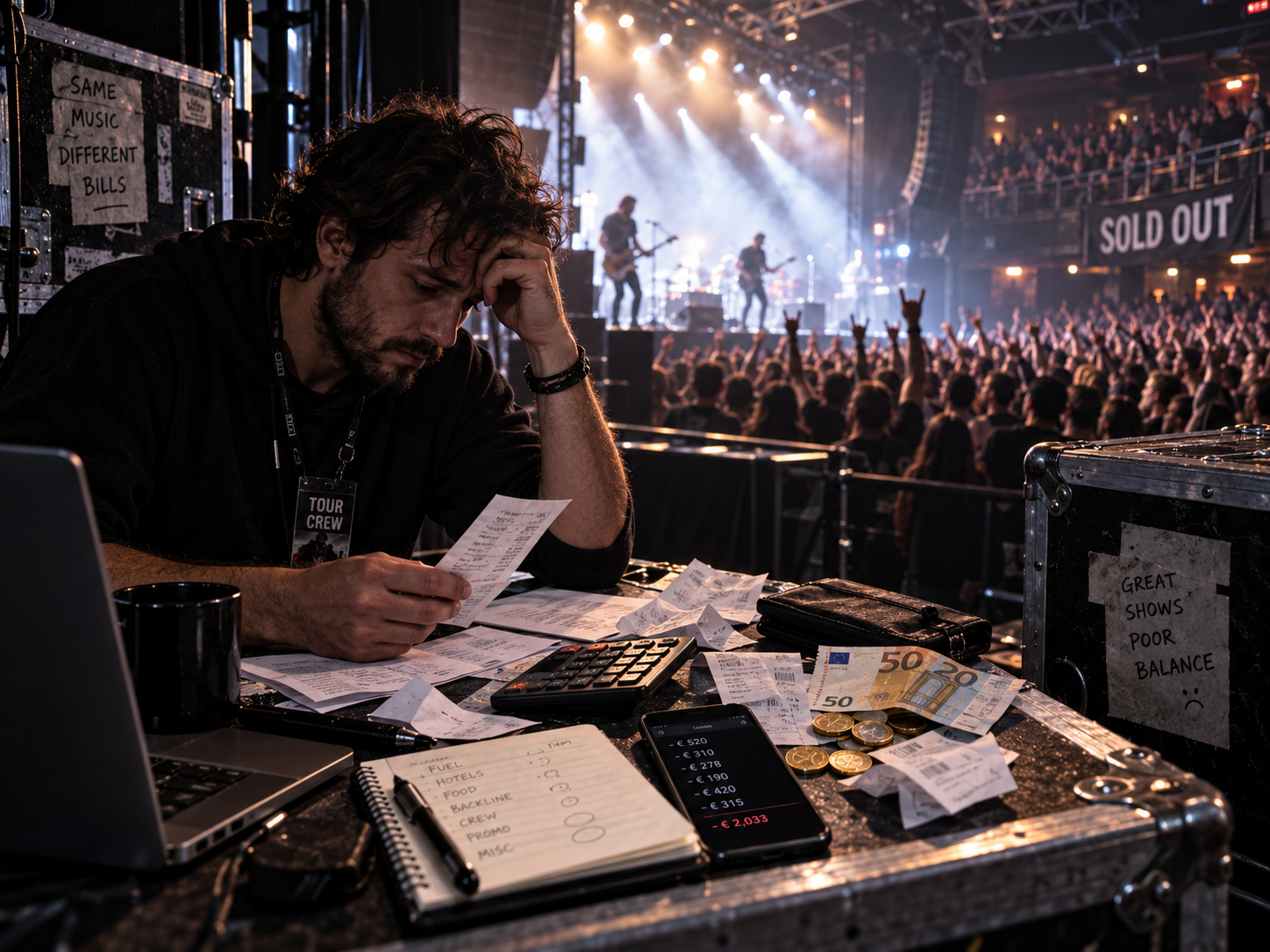
Welsh band Los Campesinos! did something unusual in a business where almost no one shows their books: they published the detailed figures for a tour.
Not a simulation. The real numbers.
Eleven shows across North America during the 2024 tour. Ten sold out completely, and the eleventh, in Boston, came very close: 853 tickets sold in a 933-capacity room.
That’s hardly what you’d call a failure.
The gross fees for the eleven shows added up to $149,037.74. After the agent’s commission, tax withholding and some extra production costs, that left $127,729.53, which the band recorded as roughly £99,738.
Then the invoices started coming in.
Visas, touring staff, transport, driver, accommodation, per diems, travel, equipment, production, accounting…
Total cost: £101,827.95.
Result from the shows: a loss of £2,089.90.
Yes: a tour that had sold out almost every single ticket had lost money, before merchandise was even factored in.
This doesn’t mean every band loses money on tour. The band itself makes clear their numbers can’t be extrapolated to the whole industry. Every artist, every country, every venue and every contract is different.
But the case is extraordinarily useful, because it dismantles an assumption we make almost automatically:
sold out = solid business.
Not necessarily.
Where Does the Money Disappear To?
Picture a room with a thousand people and a €30 ticket. The multiplication is so simple it’s irresistible.
A thousand times thirty.
€30,000.
“Wow, they must have made a killing tonight.”
But that’s not the band’s takings.
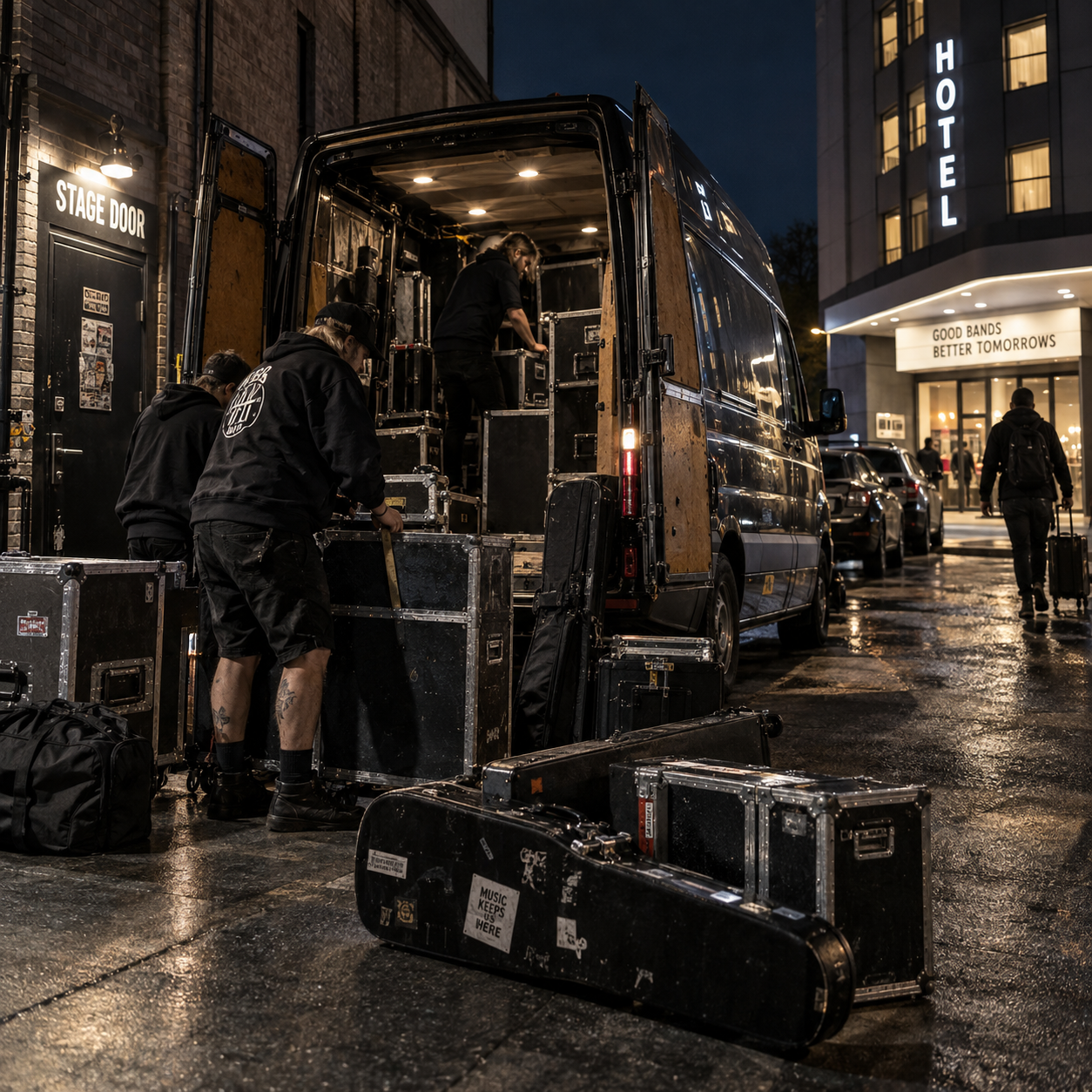
A tour needs to move people. And instruments. And equipment.
Someone has to drive. Someone has to set up. Someone has to make the show sound right. In certain productions there’ll be lighting technicians, backline crew, a tour manager, someone running merch, a photographer or content creator.
There’ll be hotels.
Fuel.
Motorways.
Parking.
Per diems.
Rentals.
Insurance.
Commissions.
And there’s an important detail the audience never sees: many of these costs exist even on the days there’s no show at all.
A band that plays Tuesday in Barcelona and Thursday in Paris is still paying on Wednesday.
The vehicle is still rented. The technician is still working. The musicians still need to sleep and eat. The gear still has to be moved. It might take a thousand kilometres of driving so that, by five o’clock the next afternoon, everything’s set up again.
When the British Musicians’ Union sets its recommended minimum rates for professional musicians, it doesn’t just factor in the length of the performance. It also accounts for set-up time, travel, mileage, fuel, tolls, parking and instrument transport. It’s a good way of understanding something we often forget: a musician’s workday doesn’t start with the first note.
And in Progressive Rock, We Complicate Things a Little Further
Tótum readers know this perfectly well.
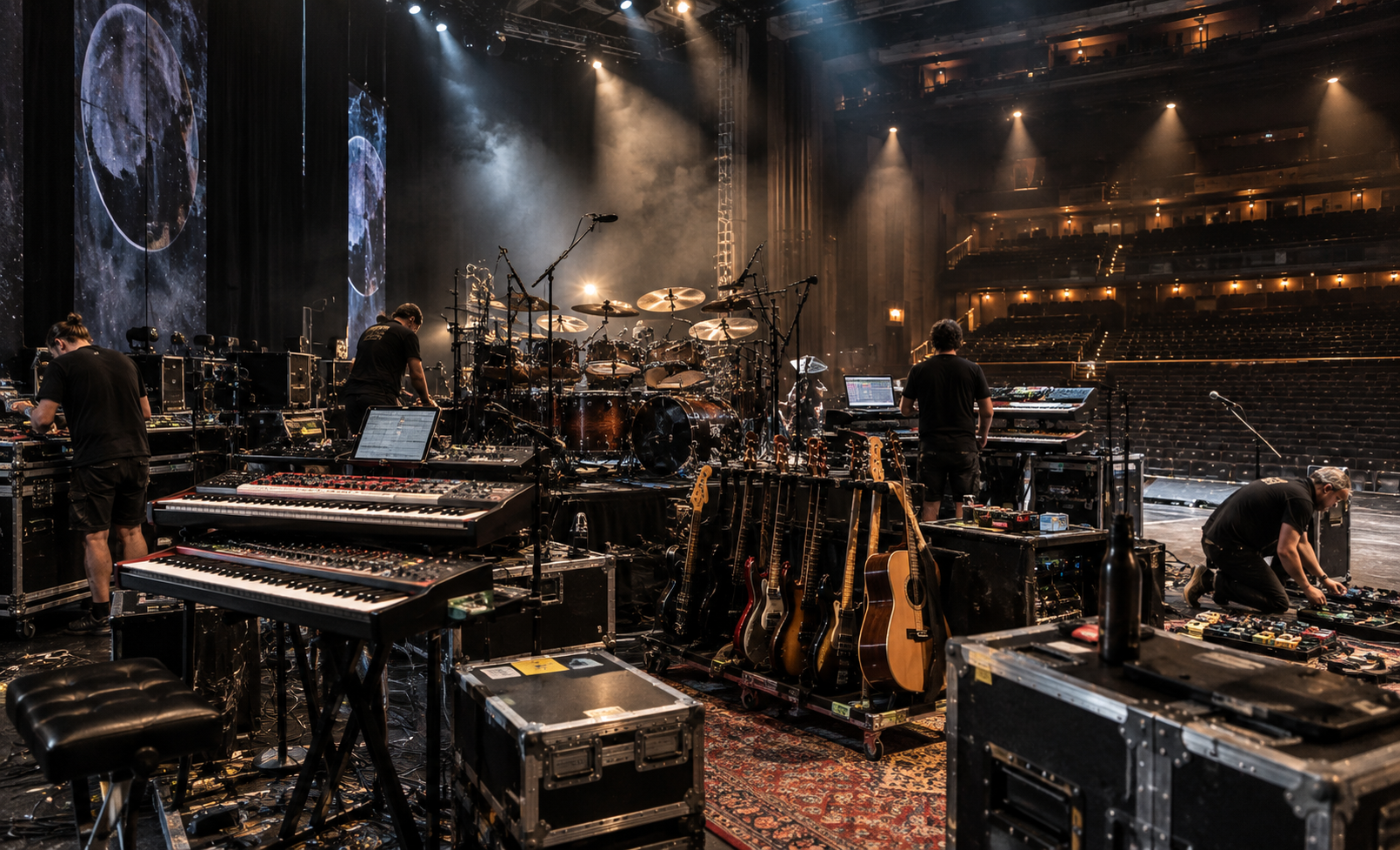
Not every band can show up to a venue with just two guitars, a bass and four cymbals.
Think of many of the line-ups that regularly fill these pages. Keyboards. Multiple guitars. Pedalboards. Acoustic instruments. Percussion. Computers. Sync systems. Visuals. Constant instrument changes. In some cases, horns, strings or additional musicians.
Productions designed to reproduce live albums with thirty, forty or fifty tracks.
All of that has to travel.
And all of that costs money.
Progressive rock also has a particular paradox of its own. It can inspire extraordinary loyalty in its audience, but many bands operate within a circuit of mid-sized venues. We’re not talking about 20,000-capacity stadiums, where an expensive production gets diluted across thousands of tickets.
When six or seven musicians put on an ambitious production for 500 people, the cost-per-attendee ratio can be considerable.
That’s one of the reasons why seeing a good prog band in a mid-sized venue remains such an extraordinary experience. It also explains why bringing that same band to our city isn’t always as simple as we think.
The T-shirt That Saves the Tour
Back to Los Campesinos!.
We’d left their tour at a loss of £2,089.90.
But there was still another till to open.
The merch till.
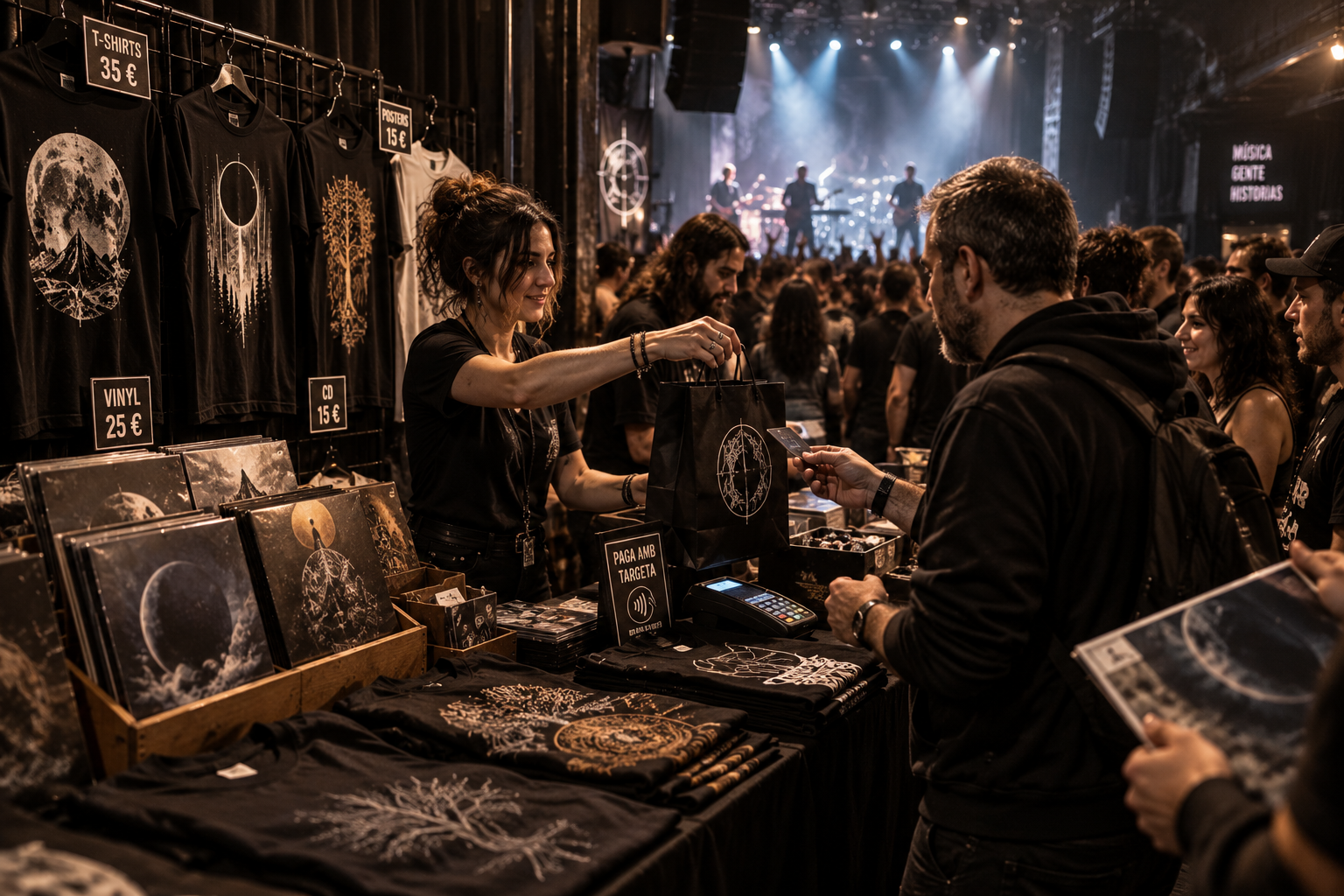
Across those eleven shows they took in roughly £88,600 in merchandise. In t-shirts alone, they sold 2,266 units.
After subtracting manufacturing, buying in records, card commissions, payment systems and transporting the merchandise, the profit from merch came to £40,336.54.
Suddenly, a tour that was down £2,089.90 turned into one showing a positive result of £38,246.64.
The box office hadn’t managed that.
It had essentially been achieved by the table at the back of the room.
And here lies one of the great transformations in today’s music business.
The t-shirt is no longer just a souvenir of the show.
It can be part of the very economic structure that allows the concert to happen at all.
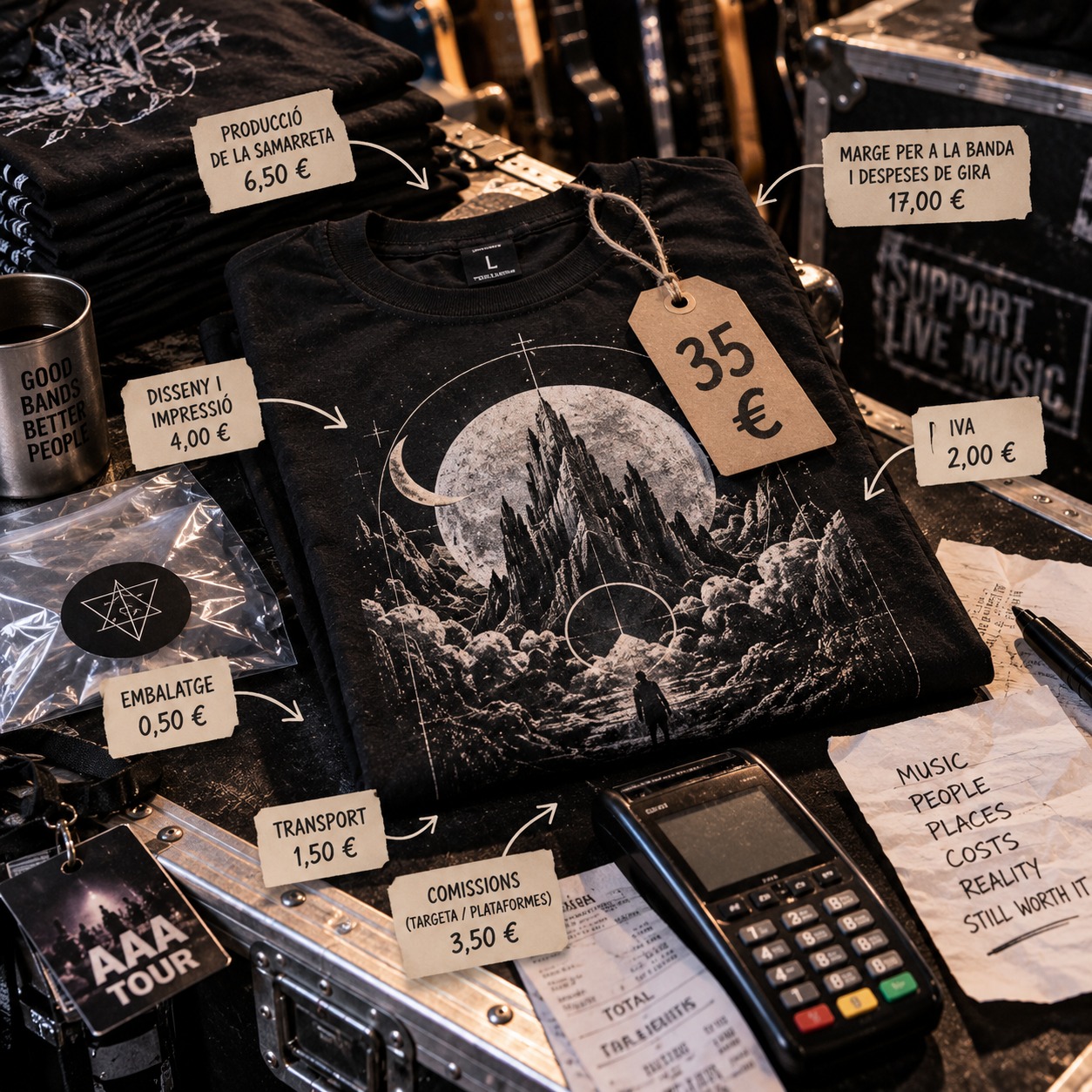
Why Does a T-shirt Cost €35?
It’s also a common thing to hear.
“Thirty-five euros for a t-shirt?”
It’s understandable. Especially when whoever’s standing at the counter has no idea what’s behind that price.
Los Campesinos! sold their tour t-shirts for $35. The most popular one, printed front and back in three colours, cost $15.99 per unit to produce.
Of that initial $35, only around $19 was left before any other expense.
After that came card commissions, a 7% cut to the system used to process payments, and the cost of transporting the merch to the shows.
On that tour they had one important stroke of luck: the venues they played didn’t take a cut of merch sales.
That’s not always the case.
The issue has caused enough friction that the British Featured Artists Coalition launched the “100% Venues” campaign, calling for venues that don’t charge commissions on artists’ merchandise. The organisation has flagged cases where commissions reached as much as 25% of gross takings, plus VAT.
Let’s think about what that actually means.
Not 25% of the profit.
25% of what the buyer pays.
The FAC argues that, for many artists, merchandise has become a vital source of income, and that loading it with these commissions puts even more pressure on tours already working with razor-thin margins.
That’s why, when we buy a t-shirt after a show, maybe we’re not simply buying a t-shirt.
We’re voting, with our wallets, for that band to be able to keep putting the miles in.
Vinyl Wasn’t Dead Either
Fifteen years ago we’d almost buried the physical format.
Today we find vinyl back on almost every merch table. Coloured editions, double LPs, special pressings, signed records, CDs, even cassettes.
It’s not just nostalgia.
It’s economics.
Bandcamp states that, on average, roughly 82% of what a buyer pays through the platform reaches the artist or label, once Bandcamp’s cut and processing costs are factored in. Its stated commission is 15% on digital music and 10% on merchandise, before payment-processor fees.
It’s a radically different model from streaming.
And not because Spotify pays some fixed amount per stream. In fact, Spotify insists that this famous “per-stream rate” doesn’t actually exist as such. Money from subscriptions and advertising goes into a royalty pool and is distributed according to each rights-holder’s share of total streams. It’s then labels, distributors, publishers or other rights-holders who pay the artist, according to their respective contracts.
That difference matters.
When you buy a record directly from a band, the economic relationship between you and the artist is relatively transparent.
When you stream a song, that relationship passes through a much more complex chain.
There’s no need to demonise streaming. It’s made it possible for a band from Sweden, Poland or Catalonia to be discovered that same afternoon by someone in Buenos Aires or Tokyo. For many bands it’s an extraordinary tool for getting their music out there.
The problem arises when we confuse audience size with sustainability.
Having listeners doesn’t necessarily mean being able to afford a tour.
Venues Do the Maths Too
It would be easy to turn this story into a tale of musicians versus venues.
It would also be pretty unfair.
Small and mid-sized venues suffer through exactly many of the same pressures: energy, rent, staff, insurance, taxes, equipment, maintenance, and shrinking operating margins.
Figures from the British Music Venue Trust are especially telling. Its 2025 report puts the average profit margin for the UK’s grassroots venues at just 2.5%. More than half, 53%, made no profit at all that year, and thirty venues closed for good.
This is where the real problem starts to show.
The band needs to earn more.
The technician needs to get paid.
The venue needs to survive.
The promoter needs to cover the risk.
And the audience has a limit too.
You can’t just set a ticket at any price.
This is the equation that a large part of live music tries to solve every single night.
The Cost of Trying to Keep Tickets Affordable
In Los Campesinos!’s case, there was another interesting decision at play. Standard tickets for their North American tour cost $27.50, and the band set aside a small allocation of $10 tickets for people on low incomes.
It’s easy to imagine the business solution.
Raise the ticket price.
But how far?
When a band goes from €25 to €35 and then to €45, the financial problem simply gets passed on to the audience.
And when going to two shows a month, grabbing a bite, getting there and buying a t-shirt turns into an outlay of €150 or €200, there comes a point where the fan has to start choosing too.
Maybe they won’t see four bands.
They’ll see two.
And that decision, in turn, ripples back onto the bands, the venues and the promoters.
It’s a far less romantic cycle than the concert photos would suggest.
The Poorest “Sold Out” in History
Social media has turned the SOLD OUT sign into a badge of honour.
And it is one.
Filling a room means there are people willing to leave the house, pay for a ticket and give two hours of their lives to listening to your music. In an age of instant consumption and infinite choice, that’s no small thing.
But perhaps it’s time to stop using “sold out” as a synonym for making money.
A band can sell out a room and still lose money.
A venue can be packed and still end the year with a miserable margin.
A musician can perform in front of a thousand people on Saturday and be back at another job on Monday.
In fact, the UK’s first-ever census of musicians already showed just how much the profession depends on juggling different activities: on average, a professional musician performed three or four different roles within the industry, while nearly half pointed to financial barriers limiting their career.
This might be one of the least visible images of music today.
The musician we admire up on stage might also, at the same time, be a teacher, a producer, a technician, a composer for hire, or working in any number of other jobs just to be able to keep being a musician.
That’s not a lack of success.
Often, it’s simply what makes it possible.
Next Time You Reach the Merch Table
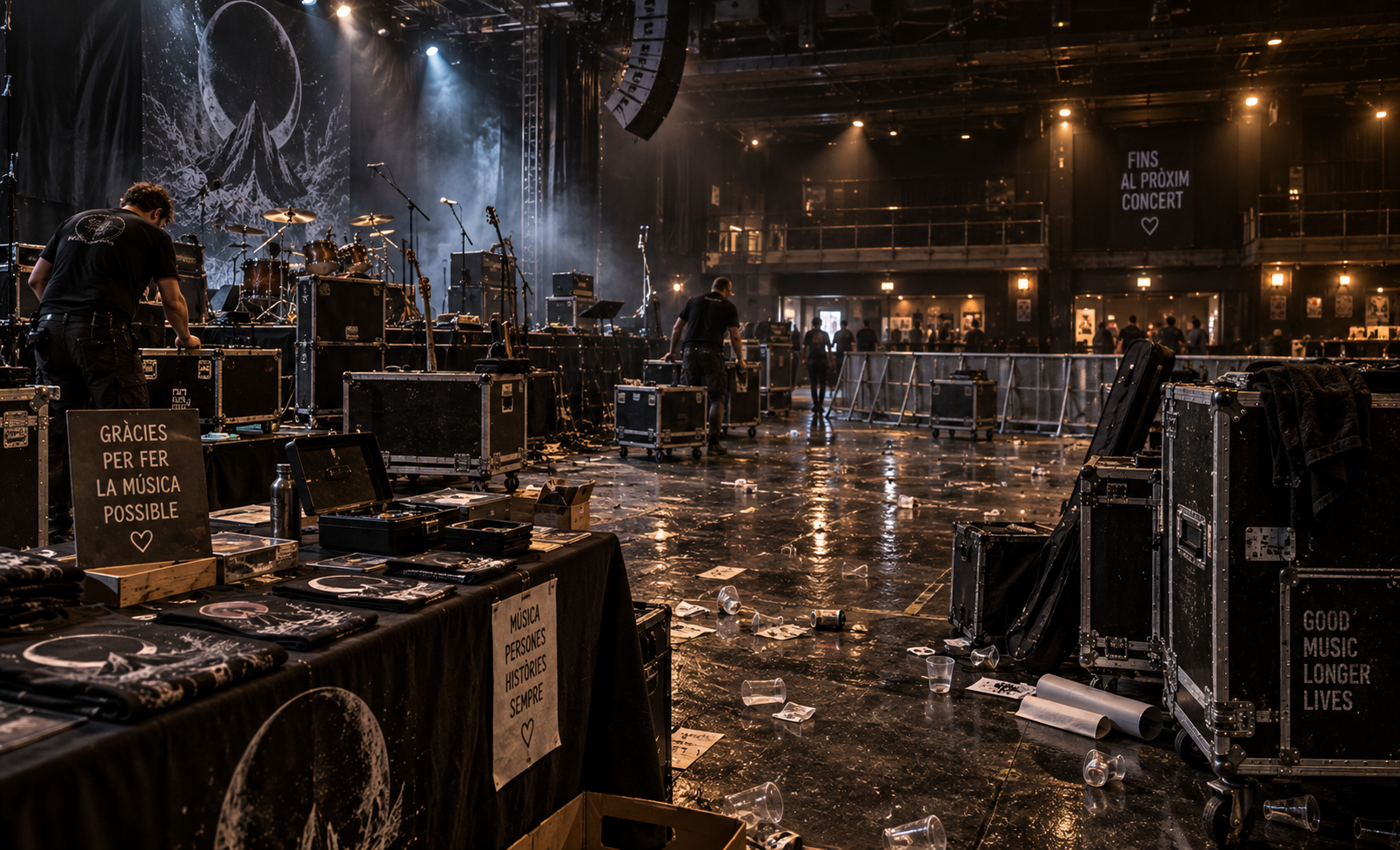
Maybe after the next show we’ll find ourselves at that table again.
A t-shirt.
A vinyl.
A poster.
Maybe we’ll look at the price and think we’ll buy something next time instead.
That’s fine. No one is obliged to financially support every band they listen to.
But it’s worth knowing what that table actually represents.
For years we were told that buying a record meant supporting an artist. Then we were told the future was going to concerts.
Now we’re discovering that even the concert itself might need a third leg to stand on.
The record.
The ticket.
The t-shirt.
Not because musicians have hit on some brilliant formula for selling us more stuff, but because the economic model of music has fragmented to the point where a single income stream can barely sustain it all on its own.
And this matters especially for the styles we love here at Tótum Revolútum.
Progressive rock, jazz, post-rock, metal, fusion, instrumental music. Genres with extraordinary audiences — loyal and curious — but which in many cases exist outside the major commercial circuits.
If we want ambitious records, seven-piece bands, carefully produced shows, and artists willing to cross Europe to play for four hundred people, something has to make the numbers add up.
Sometimes it’ll be a ticket.
Sometimes it’ll be a vinyl.
And, surprisingly, some nights it’ll be that black t-shirt we end up wearing home.
Music has always had a business side to it. The problem starts when the business stops allowing the music to happen at all.
Maybe that’s the question we should start asking ourselves.
Not how much a band earns when they sell out a room.
But how much it costs to make sure that band is actually there, in front of us, playing.
Text by Guillem Cardós